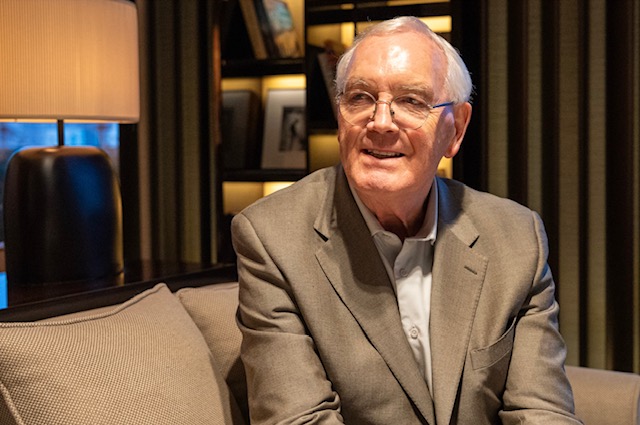
BrandBrief sat down with Tom Goddard, President of the World Out of Home Organization (WOO), during his visit to Seoul to discuss the current state of the OOH market and its vast potential.
Tom Goddard, President of the World Out of Home Organization:
“Over the past decade, the New Media market has grown nearly threefold, while the Traditional or Legacy Media market has shrunk by more than half. Despite the rapid decline of traditional media, Out-of-Home (OOH) has remained the only medium to grow, holding firm at the center. Now, empowered by digital technology, OOH is entering a new renaissance and rising as the core of modern communication.”
As digital transformation accelerates and artificial intelligence (AI) reshapes the advertising landscape, the OOH (Out-of-Home) sector - long regarded as one of the most traditional media categories - is experiencing a new boom. From large-format digital screens and 3D anamorphic displays to AI-driven real-time performance measurement, OOH is being re-evaluated as an efficient medium that blends the strengths of both new and traditional media, fueling its remarkable growth.

Goddard noted, “OOH’s share of the global advertising market has remained steady at 5% over the past decade, but its absolute size has doubled—from 25 billion dollars to 50 billion dollars.” He emphasized that “OOH is the only traditional media category that has expanded in scale while maintaining its market share.”
Today, the world faces unprecedented economic headwinds, exacerbated by geopolitical tensions, territorial conflicts, wars, and trade disputes. The advertising industry is also confronting these severe uncertainties. WPP, the world’s largest communication group, has seen its stock price fall 63% this year, with its market capitalization dropping from 32 billion dollars to roughly 3–5 billion dollars.
“In spite of these challenges,” Goddard explained, “OOH has continued to hold its ground and attract major investment, demonstrating the fundamental strength of its industry structure.” As media environments shift rapidly, “people want media they can trust and that deliver strong impact - and OOH is the medium that best fulfills these needs.”
With the proliferation of fake news on social media and AI-generated manipulated content, audiences increasingly find themselves asking, “Is this real or fake?” In contrast, OOH - rooted in physical public spaces - holds the highest levels of trust and authenticity among all media. According to one study, consumer trust in TV stands at 18%, social media at 12%, and influencers at 11%, while trust in OOH reaches 21%.
Beyond simply delivering advertising, OOH also enhances public life, contributing to its rise. Through OOH infrastructure, people gain access to free Wi-Fi, device-charging stations, emergency messaging services, and public amenities such as benches and bus shelters.

“Providing civic benefits through the most trusted medium - OOH - while generating supplemental public revenue can help reduce the tax burden on citizens. It’s a win-win for everyone,” Goddard said. “Brands, too, are increasingly recognizing OOH’s strengths and realizing the need to shift part of their online activation budgets back into this trusted channel.”
He described Seoul as a “paragon of OOH utilization.” WOO selected Seoul as the host city for the APAC Forum precisely to highlight its exemplary case. The forum, held from November 5 to 7 at the JW Marriott Dongdaemun Square, attracted more than 450 global OOH professionals.
“Seoul is a world-leading city in its use of large digital screens within dense urban environments,” he said. “These stunning, immersive digital OOH displays express the city’s identity - sending the message that ‘Seoul is smart, forward-looking, and actively communicating with its citizens.’”
He noted that he was especially impressed by the open-minded and progressive approach of Seoul city officials and the strong partnerships supporting OOH. Collaboration among advertisers, agencies, the Korea Outdoor Advertising Association (KOOHA), and government bodies is driving rapid advancement in Korea’s OOH ecosystem.
“Major cities such as Oxford Street in London and Wangfujing in Beijing are transforming their central districts into pedestrian-only zones filled with bright, dynamic digital OOH,” he said. “In the UK, there’s even a saying that ‘an outdoor space without advertising has no value.’ The role of OOH in city centers has never been more important. The world is watching Seoul’s success, built through close cooperation with public institutions.”
Despite its strong momentum, the OOH industry still faces significant challenges: accurate performance measurement, ROI (Return on Investment), digital transformation, and automation.
“Many advertisers know OOH is effective, but proving ROI with precise data remains a shared challenge for the industry,” Goddard said. “Metrics like eyeballs and visibility can be measured with great accuracy, but quantifying the medium’s direct impact on sales requires deeper research. We’re working closely with multiple data companies to improve this.”
He also introduced the concept of ROW - Return on Wow. “A recent neuroscience-based study found that messages viewed on large OOH screens are remembered far longer than those seen online or on TV. Humans are naturally more responsive to large, impactful stimuli.”
In simpler terms, although an online banner, a newspaper ad, and an OOH display may each count as one “impression,” their actual impact varies substantially. Goddard also emphasized that OOH remains the most cost-efficient medium: its CPM ranges from $2 to $16, which is only about 25% of TV’s CPM.
“Outstanding creativity displayed through OOH naturally spreads to social media and TV without additional media cost,” he added. “For this reason, more advertisers are planning OOH campaigns with these amplification effects in mind. Properly redefining the true value of OOH effectiveness is essential.”
He also highlighted several elements that will further unlock OOH’s potential: accelerating digitalization (currently only around 10% of global OOH is digital), and improving automated OOH trading systems to make buying as seamless as online media.
“OOH is a medium that has continually adapted, invested, and reinvented its market value amid rapid shifts in the media landscape,” Goddard concluded. “From its roots as the original mass medium, OOH has been supercharged by digital technology and now stands at the center of modern communication. With continued investment in digital transformation, the growth potential of OOH is virtually limitless.”
Founded in 1959, WOO is a global non-profit organization representing more than 280 member companies across 120 countries. It is dedicated to advancing the OOH industry through innovation, development, and international collaboration.
Original Article published on LinkedIn here.
WOO PARTNERSThe organisations powering Out of Home worldwide
Platinum Annual Sponsor



Gold Annual Sponsor


Silver Annual Sponsor

Global Exhibitor Sponsor

Event Supporters
Event Gold Sponsor
Event Silver Sponsor

Event Sponsor

Event Exhibitor



billups
Platinum Annual Sponsor
billups is an independent global out-of-home (OOH) agency helping advertisers, agencies and OOH media owners strengthen media performance through a patented analytics and measurement platform. With over 20 years of experience and employees spanning 19 countries, their team unites local OOH expertise with global accessibility to actualize international marketing initiatives. billups uses proprietary and patented AI-powered technology to plan, optimize and report on media effectiveness, making OOH an indispensable part of media plans.
Discover how billups is reinventing OOH for the performance age at www.billups.com.
Broadsign
Platinum Annual Sponsor
Broadsign is making it easier than ever for media owners, agencies and brands to harness the power of out-of-home and connect with audiences across the globe. Powering over 1 million signs in airports, shopping malls, health clinics, transit systems, and more, Broadsign is at the heart of people’s lives.
The Broadsign platform helps media owners more efficiently manage their business operations while enabling brands and agencies to easily book OOH campaigns. The platform includes tools for content distribution, playback and proof of performance; sales inventory availability and proposal generation; automated programmatic DOOH transactions; and OOH business operations.
Daktronics
Platinum Annual Sponsor
Founded in 1968, Daktronics is recognized worldwide as the leading designer and manufacturer of electronic scoreboards, programmable display systems, advertising displays and large screen video displays using LED technology. The company has installed more than 35,000 individual video-capable displays in more than 80 countries around the world and has multiple international manufacturing and office locations. These displays inform and entertain people throughout the world including thousands of digital billboards and many custom Out Of Home digital advertising displays in places like Times Square, New York, and Piccadilly Lights in London. Recently the company installed an 8,000 sq. ft. LED video display system at Rogers Centre, Toronto, Canada.
Media Resources
Platinum Annual Sponsor

Innovating the Future for the Digital OOH Industry
As one of the leading North American LED display companies, Media Resources stands at the forefront of innovation. Our mission is simple: increase the addressable market and ROI for our OOH customers through innovative and leading digital solutions across spectaculars, roadside, airports, transit, and street furniture. At our WOO booth we will demonstrate what we have don’t to accomplish this mission.
As a 60-year-old company operating in North America, our comprehensive expertise spans engineering, design, manufacturing, installation, and service, ensuring that every project is executed to perfection. With the current geopolitical environment and our mastery of the industry in North America it is now time for us to expand our side of North America. We are pleased to be doing that as part of WOO!
If you’re a leading OOH media company seeking impactful advertising solutions to enhance your visibility, Media Resources is here to provide innovative LED display solutions and unparalleled support.
Moving Walls
Platinum Annual Sponsor

Moving Walls is a media technology group with a presence in seven markets across four continents. The group operates a myriad of technology for both the demand and supply sides of Out-Of-Home (OOH). For planners and buyers, Moving Walls operates ‘Moving Audiences’, a patented multi-sensor approach to location-based media measurement like billboards, digital signage, and transit media. For asset owners, the group’s supply-side subsidiary, Location Media Xchange (LMX) is a platform for marketers to profile locations based on the types of audiences around the site and activate mobile and physical place-based media like digital billboards to reach them during this offline journey.
MMG
Platinum Annual Sponsor

Headquartered in the United Arab Emirates, with offices in Abu Dhabi and Dubai, BackLite Media are a specialist Out of Home media company renowned for its innovative approach and commitment to pushing the boundaries of advertising.
As the leading partner with the Roads and Transport Authority (RTA), BackLite Media boasts stand-out locations along the iconic Sheikh Zayed Road. These premier locations, combined with operations in high-profile malls, destinations, and cinema advertising venues, including The Galleria Mall, Al Qana, and Dubai Festival City, position BackLite Media as a key player in delivering unparalleled advertising reach throughout individuals' daily journeys in the UAE.
BackLite Media's success is a testament to its ability to adapt to the dynamic advertising landscape while maintaining a commitment to creativity and innovation as the company continues to shape the future of Out of Home media.
Perion
Platinum Annual Sponsor
Hivestack is the largest independent, global, full stack, marketing & ad tech company, powering the buy and sell side of programmatic digital out of home (DOOH) advertising. On the buy side, marketers use Hivestack’s Demand Side Platform (DSP) to create measurable campaigns that activate DOOH screens in real-time based on consumer behavior and audience movement patterns. On the sell side, DOOH media owners use Hivestack’s Supply Side Platform (SSP) & Ad Exchange to attract programmatic revenue. DOOH media owners can also use Hivestack’s Ad Server to power impression-based, directly sold campaigns. Our suite of solutions allows advertisers to plan, activate and measure DOOH campaigns at scale.
Vistar Media
Platinum Annual Sponsor
Vistar Media is the world’s leading end-to-end programmatic ecosystem for digital out-of-home (DOOH). Vistar Media’s demand-side platform (DSP) and supply-side platform (SSP) empower buyers and sellers to easily transact on DOOH inventory, while applying intelligent data insights that improve media performance. Vistar’s SaaS solutions (unified ad server and Cortex for device and content management) deliver enterprise-grade solutions for monetizing and operating digital signage networks at any scale.
Founded in 2012, Vistar Media is headquartered in New York City and has offices across the United States, Canada, EMEA and APAC. Through its global reach, direct platform integrations, data partnerships, and complete technology stack, Vistar Media continues to power innovation and growth across the digital out-of-home industry.
AllUnite
Gold Annual Sponsor
AllUnite is a global adtech company that specialises in OOH advertising audience measurement and analytics. Its technology provides real-time data on audience behaviour and ad exposure, enabling OOH media owners, advertisers, and agencies to make data-driven decisions and optimise campaign performance.
AllUnite's solutions include digital sensors and holistic data analytics tools. Headquartered in Denmark, and with offices in Italy, and Brazil, AllUnite caters to a diverse clientele across the globe.
Ipsos
Gold Annual Sponsor

Ipsos - world leader in Out of Home measurement.
Ipsos operates OOH solutions in 17 different countries. (11 recognised industry currencies). We offer the most accurate and reliable insights for media owners, media agencies and brands. People-centric measurement Ipsos provides a total understanding of audiences. Our approach centres around understanding people and is how we build solutions reflective of local environments. We leverage the best in technology, national data sources and our research expertise to deliver realistic representative OOH data for any market need.
Global Expertise Ipsos is present in over 90 different countries. Our local knowledge is supplemented by a central global OOH team which includes the expertise of MGE Data. (OOH Data and Technology specialists who design, develop and manufacture equipment and software.) This mix of global and local expertise enables us to offer tailored contemporary solutions, ensuring our clients have the most accurate datasets for media planning and advertising. We continually invest in our audience measurement capabilities.
Our scale and expertise in data science ensures our tools are future ready. We help our clients to unleash the power of audiences.
VIOOH
Silver Annual Sponsor
VIOOH is a leading premium global digital out of home supply-side platform that connects buyers and sellers in a premium marketplace, making OOH easily accessible.
Led by a team of digital OOH and programmatic tech experts, VIOOH is pioneering the transformation of the OOH sector, championing its role in enhancing omni-channel digital campaigns through the use of programmatic capabilities and data. VIOOH currently trades programmatically in 22 markets and provides access to inventory from some of the world’s top DOOH media owners, including APG, Branded Cities, Framen, In-store Media, JCDecaux, Media Frankfurt, Media Transports, and more.
For more information about VIOOH, please visit www.viooh.com or follow us on X (Twitter) and LinkedIn.
Absen
Global Exhibitor Sponsor
Established in 2001, Absen Optoelectronic Co., Ltd (SZSE: 300389) is a trusted global brand providing LED display solutions and services. Featuring reliable visual performance and proven product quality, Absen’s LED displays have been exported to over 120 countries and regions around the world.
Amongst the Chinese manufacturers of LED, Absen has been ranked number one Chinese exporter for the last, consecutive, nine years. With more than 30,000 successful installations in OOH advertising, retail, sports, entertainment, spectaculars, branding, corporation and broadcasting, Absen has an LED product solution for every application.
As a truly global company, Absen continues to develop its international sales and service network globally with 18 subsidiaries. For our Latin American partners and customers, we have two subsidiaries in Latin America, located in Mexico and Brazil. The Mexican subsidiary is located in Polanco, Mexico City, the Brazil subsidiary is located in Vila Olimpia, Sao Paulo, and we welcome the opportunity to meet you and demonstrate the proven quality and cost-effectiveness of our award-winning products.
SEIBIDOUCo., Ltd
Event Gold Sponsor
Seibidou Co., Ltd. is a company in Japan, specializing in the planning, manufacturing, and installation of outdoor signage, LED displays, and digital signage.
With its original brands “SLED VISION” and “FieldBoard,” the company has an extensive track record of installations at construction sites and commercial facilities nationwide. With cutting-edge technology and design expertise, Seibidou creates unforgettable moments of surprise and excitement.
For more information about us, please visit
CUZ ART
Event Silver Sponsor
Cuz is an interactive media art studio that merges technology, emotion, and design to create immersive digital experiences.
We transform public spaces into poetic, interactive canvases where people and art coexist.
Through media façades, digital signage, and AR, Cuz expands the relationship between people, space, and beauty—seeking harmony between technology and human emotion.
Our works have been internationally recognized, earning honors such as the iF Design Award, Asia Design Prize (Gold and Grand Prize), and the Korea Design Awards, reflecting our commitment to innovation and artistic excellence.
JEKI
Event Silver Sponsor
JR East Marketing & Communications, Inc. (jeki) is a comprehensive advertising company and a media company that owns OOH media. Leveraging its strengths in utilizing public transportation such as stations and trains, it continuously makes innovative, unrestricted plans come true.
In April 2023, jeki launched MASTRUM, a platform business focused on OOH media. As a media owner, jeki is developing a platform that facilitates transactions across domestic OOH media, aiming to enhance the overall value of the market. This initiative promotes the automation of media buying with greater efficiency and additional value, covering various OOH formats including digital signage in urban areas.
JCDecaux Korea
Event Sponsor
제이씨데코 코리아는 세계1위의 아웃오브홈미디어 전문기업 제이씨데코 그룹의 한국지사로 2001년 서울에 설립되어 도시경관 개선 및 시민을 위한 쾌적한 거리환경 조성을 사명으로 지자체와 협력하며 공공디자인 발전을 위해 노력합니다.
2004년 중앙차로 버스정류소를 국내 최초 도입하였으며 2017년에는 종로 중앙차로 버스정류소에 세계최초로 이동형 버스승차대를 개발 도입하였습니다.
제이씨데코 코리아는 서울시 전역의 중앙차로 버스정류소, 가로변 버스정류소, 마을버스정류소, 환승센터, 관광안내판 등 각종 공공시설물의 디자인부터 설치, 운영, 유지관리에 이르기까지 가로시설물을 통합적으로 관리 운영합니다.
History
- 2004 서울시 중앙차로 버스승차대 운영
- 2006 대한민국 공공디자인대상 최우수상 수상
- 2017 종로대로 중앙차로 버스승차대 운영
- 2018~ 연등행사를 위한 종로 중앙버스승차대 이동 및 재설치 프로젝트 수행
- 2022 서울시-뉴욕관광청 도시 공동 관광마케팅 옥외광고 지원
- 2023 서울시 4차 중앙차로 버스승차대, 여의도/서울역/청량리 환승센터, 가로변 버스쉘터 운영
- 2023 서울관광재단 서울시 홍보 옥외광고 지원
- 2023~ 서울시 정류소 아트갤러리 운영
JCDecaux Korea
JCDecaux Korea is the Korean subsidiary of the JCDecaux Group, the world’s number one Out-of-Home media specialist. Established in Seoul in 2001, its mission is to improve the urban landscape and create a pleasant street environment for citizens. JCDecaux Korea cooperates with local governments and strives for the development of public design in the city.
In 2004, it introduced central bus platforms in Korea for the first time, and in 2017, it developed and introduced the world’s first movable bus shelter at the Jongno central bus platform. JCDecaux Korea holistically manages and operates street furniture across Seoul, covering everything from design and installation to operation and maintenance of various public amenities, including central bus platforms, roadside bus shelters, town bus shelter, transfer centers, and tourist information boards.
History
- 2004 Operation of Central Bus Platforms in Seoul
- 2006 Awarded the Grand Prize at the Korea Public Design Awards
- 2017 Operation of Jongno Central Bus Platforms
- 2018~ Executed the project for moving and re-installing the Jongno Central Bus Platforms for the Lotus Lantern Festival
- 2022 Supported OOH advertising for the Seoul Metropolitan Government-NYC & Company joint city tourism marketing campaign
- 2023 Operation of the 4th phase of Central Bus Platform in Seoul, Transfer Centers at Yeouido/Seoul Station/Cheongnyangni, and Roadside Bus Shelters
- 2023 Supported OOH advertising for the Seoul Tourism Organization's Seoul city promotion
- 2023~ Operation of Bus Shelter Art Gallery in Seoul
Mobilytics
Event Sponsor
Mobilytics, a leading measurement and analytics provider for the out-of-home (OOH) advertising industry, provides real-time, one-to-one, privacy compliant measurement capabilities. This new full-stack solution for all media types provides volumetric and dwell time measurement under OAAA & World OOH measurement guidelines.
ALL IS WELL
Event Exhibitor
ALL IS WELL is Korea’s leading OOH company specializing in OOH media development and agency services.
Founded in 2011, the company has rapidly grown over the years through strategic media development and integrated services. It is the first company to own and operate media at both Gimpo and Jeju International Airports - two airports that connect the world’s busiest air route.
Recently, Roadblock Yeoui 12, a synchronized digital highway billboard network of 12 large-format screens, was added to its portfolio, setting new momentum in Korea’s digital OOH market.
Pushing the boundaries of what outdoor media can achieve, ALL IS WELL continues to lead the evolution of urban media innovation.
Blooming Terra
Event Exhibitor
BloomingTerra is a global ambient OOH media company based in Seoul and Los Angeles. We own and operate premium wallscapes and landmark digital assets in key cultural districts such as Seongsu and the Han River in Seoul, and Hollywood, Melrose, and Sunset in Los Angeles.
In partnership with the City of Seoul, we recently launched ferry and riverside media along the Han River—introducing the first and only moving media in Seoul’s most iconic landscape.
By transforming neighbourhoods into immersive brand experiences, we help global brands connect with audiences in memorable ways. With more than 100 campaigns executed annually, BloomingTerra delivers proven expertise, creativity, and trusted execution.
City Screen
Event Exhibitor
City Screen by Adtech.Systems is a professional OOH software tailored for media owners, enabling them to make the most of their inventory using interconnected IT solutions for out-of-home business automation.
The software ecosystem consists of three products: CRM, designed for both static and digital inventory; a flexible CMS solution integrated with various external software; and a user-friendly SSP for maximizing revenue with advanced DOOH sales.
SPOTZI
Event Exhibitor

Spotzi turns every Out-of-Home (OOH) location into a beautiful story - one backed by data. By combining audience insights, mobility data, and powerful visualization tools, Spotzi helps media owners, agencies, and brands truly understand each OOH location.
This deeper understanding drives stronger engagement with passers-by and, ultimately, greater campaign effectiveness and revenue.
Star Vision
Event Exhibitor
Starvision, a member of the World Out of Home Organization (WOO), operates a 23,000 sqm factory and brings over 20 years of experience in the design and manufacturing of out-of-home street furniture and digital displays.
By integrating classic furniture with LED and LCD digital screens, Starvision delivers smart, well-designed infrastructure for cities and media owners.
We serve global media clients with both standard and custom-built products. Each year, over 6,000 screens and structures are installed in airports, metro stations, shopping malls, and urban streets, including digital totems, signage, and bus shelters.
We stay humble, embrace new technologies, and believe that details define quality.