The next chapter for outdoor LED: it’s no longer about brightness, it’s about energy efficiency
Absen, exhibiting at the WOO Central European Forum in Warsaw this week, has published a white paper that every DOOH media owner with an electricity bill should read. Energy Efficiency in Outdoor LED Display Technology sets out where the power in a conventional outdoor screen actually goes, why dimming is not saving, and what a full-chain approach to efficiency is worth over five years. The full paper is available to download below.
Outdoor LED has spent two decades competing on brightness. Absen’s argument is that the contest has moved on. Electricity now typically accounts for more than 30% of an outdoor display’s operating cost, conventional units draw 5–15% more power every two years as components age, and energy ratings and carbon footprint reports have become mandatory prerequisites in EU and municipal tenders. For a media owner, the trade-off between a bright screen and the bill for running it is no longer just an operational concern; it decides whether you can bid at all.
The white paper is written as a full-chain energy efficiency and ROI guide for Out of Home media operators, built around Absen’s A25 Low-Carbon Outdoor Display Series. It covers the sources of power loss in a traditional display, a system-wide approach to reducing them, savings quantified by application, three real-world case studies, the certification landscape, and Absen’s R&D roadmap to 2029 and beyond.
Absen brings 26 years of outdoor display innovation to the subject, and its expertise runs the full length of the chain, from LED chips and driver ICs to power supplies, AI algorithms and cloud platforms. That is what makes the paper useful: rather than a single efficient component, it treats the screen as a system and shows how much of the saving comes from each link, with measured figures at every stage and real installations to back them up.
per square metre per day: the A25’s daily power draw under partial-load conditions
overall electricity saving, with no loss of brightness
optional factory warranty and a zero-down-payment programme
Where the energy budget leaks
The paper’s starting point is a breakdown of a conventional outdoor display’s power consumption: LED lamps account for 60–70%, driver and control circuitry 10–20%, switching power supply conversion loss 15–20%, and auxiliary cooling 5–20%. Taken together, only 40–45% of the electricity a traditional screen consumes becomes visible light. More than 55% is invalid loss: thermal loss from chip inefficiency and voltage mismatch, fan cooling that itself generates heat, and standby loss from fixed high-voltage supplies.
In Absen’s 14-hour-a-day test with adaptive dimming on, a traditional display averaged 300 W/m². The A25 averaged 112 W/m² at identical brightness: at least 50% less power on white content, at least 60% less on dynamic video, and at least 40% less at night.
Five ways the A25 turns waste into savings
18 cd/W luminous efficacy, eight times the certification baseline. Lower drive current means less heat and slower lumen decay.
Common-cathode dual-voltage architecture removes resistive heat for a 15%+ baseline cut, with no long-term field re-calibration.
Power factor up to 0.99 against an industry norm of 0.75 cuts new-site electrical CAPEX by around 30% and keeps existing cables on retrofits.
The IDES intelligent energy management system reads content frame by frame: at least 50% off white, 60% off video, and automatic dimming after dark.
A fanless, IP66-sealed all-aluminium cabinet: no fan power, no clogging, and near-zero thermal decay over five to ten years.
Proven in the field
The savings chapter models a 300 m² display over five years. Electricity, CAPEX and OPEX combined, the A25 saves more than USD 200,000; the electricity alone is 1,441,750 kWh, or around USD 360,000 at $0.25/kWh. Three case studies back the model: a 750 m² 3D landmark in Kuala Lumpur’s Golden Triangle delivering 50%+ savings in tropical high humidity on a ten-year warranty; Clear Channel’s landmark advertising towers in the United Kingdom, more than 1,000 m² of screen with site energy cut by a third and a TÜV SÜD product carbon footprint; and a 2,570 m² 360-degree canopy ring at the Prince Moulay Abdellah Stadium in Morocco, an Africa Cup of Nations venue.
The paper also sets out the certifications that now decide tender access, including TÜV CE, EU ErP, TÜV SÜD PCF and RoHS/WEEE, and the support that follows a sale: service in 165 countries, 48-hour response, annual health checks and a warranty of up to ten years. Media owners can also send Absen their screen size, local power rate and operating hours for a customised five- or ten-year energy and payback analysis within three business days.
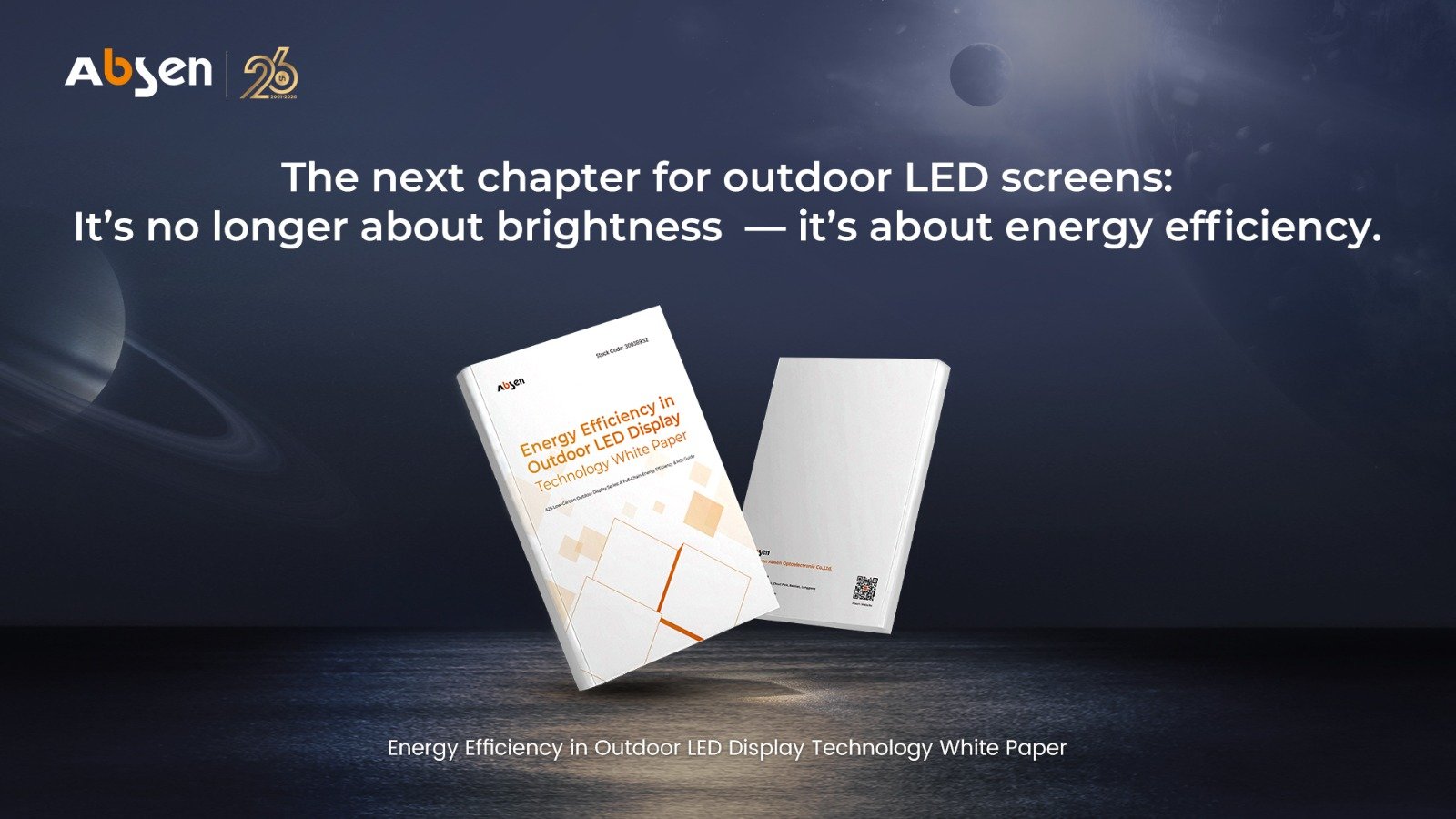 Energy Efficiency in Outdoor LED Display Technology: A25 Low-Carbon Outdoor Display Series, a full-chain energy efficiency and ROI guide
Sustainability is one of WOO’s four strategic pillars, and the medium’s case as a responsible occupant of public space rests in part on the energy its screens consume. Work like this, which puts measured numbers against the claims, is exactly what the industry needs more of. Absen is exhibiting at the Central European Forum in Warsaw this week; if you are there, go and talk to them.
Download the white paper
Energy Efficiency in Outdoor LED Display Technology (PDF, 14 MB), published by Shenzhen Absen Optoelectronic Co., Ltd., September 2026.