The enemy at the gates: how the bans spread, and how to stop them
Kai-Marcus Thäsler on the domino effect, Tamás Bauer on Hungary’s “OOH Armageddon”, and lessons from Poland and Austria
In the regulation session at the WOO Central European Forum in Warsaw, WOO Vice-President Kai-Marcus Thäsler set out how restrictions on Out of Home are spreading from city to city and country to country, why they are rarely about revenue, and what WOO is building to stop them. He was followed by the most sobering case study of the year, and by two market leaders with very different experiences of living with regulation.
Few people in the industry track the subject more closely than Kai-Marcus Thäsler. The Managing Director of Germany’s Bundesverband Aussenmedien (FAW) and WOO Vice-President runs a nightly crawler across the world’s news and legislative feeds. It now delivers around five messages a day about a new ban, restriction or consultation somewhere in the world.
His title, The Enemy at the Gates, was deliberately dramatic; his argument was anything but. Advertising bans, he told the Warsaw audience, follow a pattern, and the pattern is the problem.
Bans start with a product category that nobody wants to defend. They are adopted at city level without an impact assessment, they survive in court, and then they become a template for the next city. “Banning advertising is symbolism,” he said. The trouble with symbolism is that it compounds.
Click a chapter to open the video at that point, with sound.
The domino effect 00:00
Thäsler opened with Amsterdam, which on 1 May 2026 became the first capital with a legal ban on advertising for meat and fossil fuels, citywide and for every operator. Meat advertising, he pointed out, accounts for 0.1 per cent of Amsterdam’s Out of Home market. Fossil fuels account for 4.3 per cent. On the numbers alone, nobody in the room should care.
The precedent matters because there are so many ways to switch off a medium, and because they are available at every level of government. Thäsler’s taxonomy has six entries.
Tobacco, alcohol, gambling, HFSS food, fossil fuels, meat, and since September, fast fashion.
Total billboard bans, size caps and removal programmes.
Restrictions on DOOH motion, dwell times, brightness and night switch-off.
Schools, heritage zones, landscapes and roadsides.
Camera-based audience measurement and AI rules.
Advertising fees and advertising taxes.
The most dangerous level, he argued, is the city: fast, symbolic, usually without an impact assessment, and instantly copyable. From his own monitoring he picked out four trends.
From tobacco in Italy in 1962 to fast fashion in Bristol in September 2026, each new category is smaller in revenue and bigger in symbolism. No ban, once in place, has been lifted. “Nobody bans the last category first.”
The Hague, Vernier and Lancy in Switzerland and the Stockholm region have all seen local bans upheld. A local ban that survives in court becomes a template for every other city. The counter-example is Lyon, whose blanket digital ban was struck down because courts demand local justification.
Zurich has voted to remove all digital screens, France switches off every illuminated ad between 1am and 6am, and Paris cut advertising surface by 40 per cent. The target is no longer what the industry shows but that it exists, with luminance and light pollution the new line of attack.
Betting ads have come off public space in Rio and are under vote in São Paulo; Bulgaria has announced a gambling-ad ban; Lithuania banned outdoor gambling ads last year; and on 8 October the Polish Sejm passed a total alcohol advertising ban, including beer, by 400 votes to 33. “It’s happening here, now.”
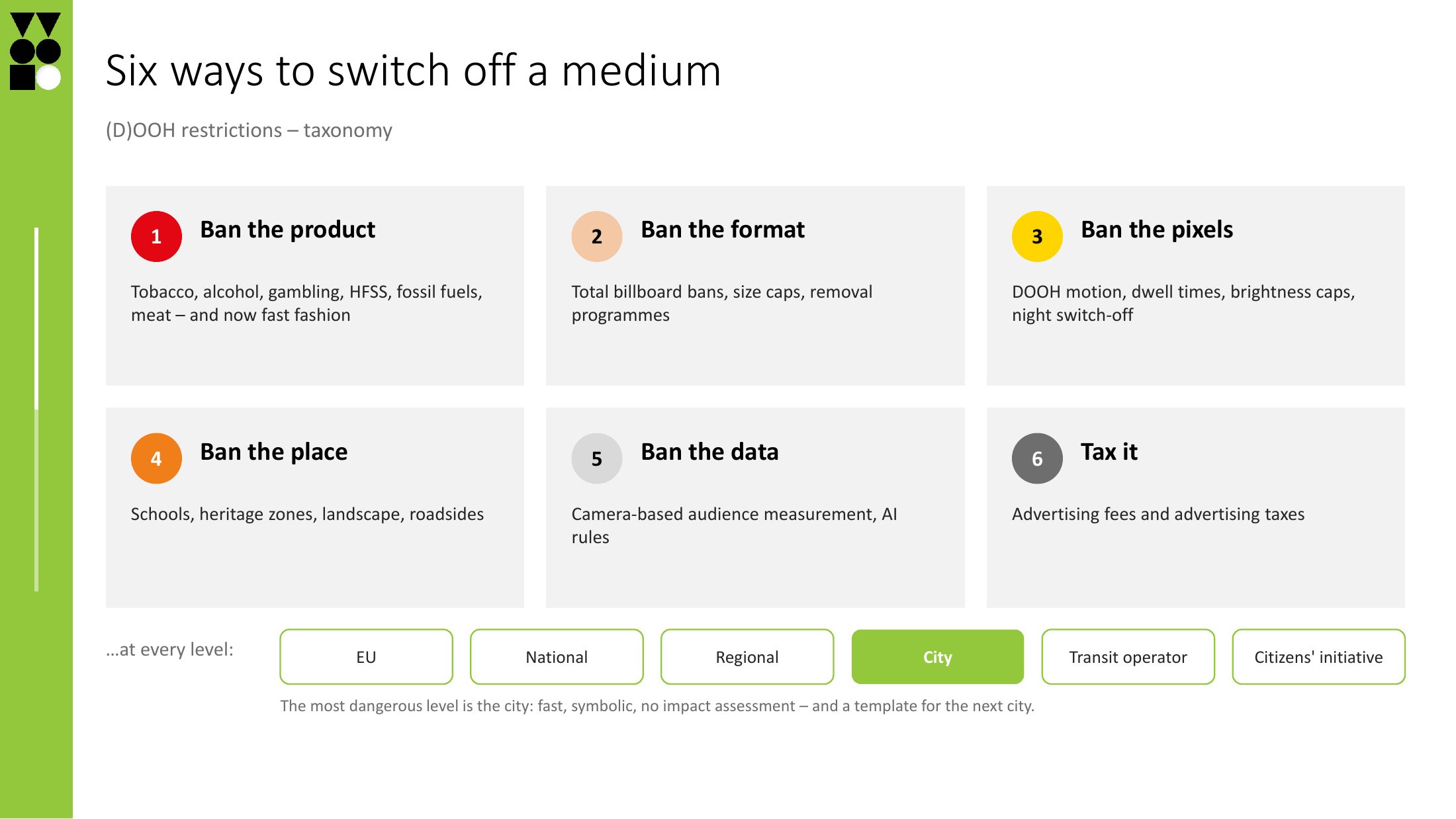 Six ways to switch off a medium, available at every level of government. Slide: Kai-Marcus Thäsler
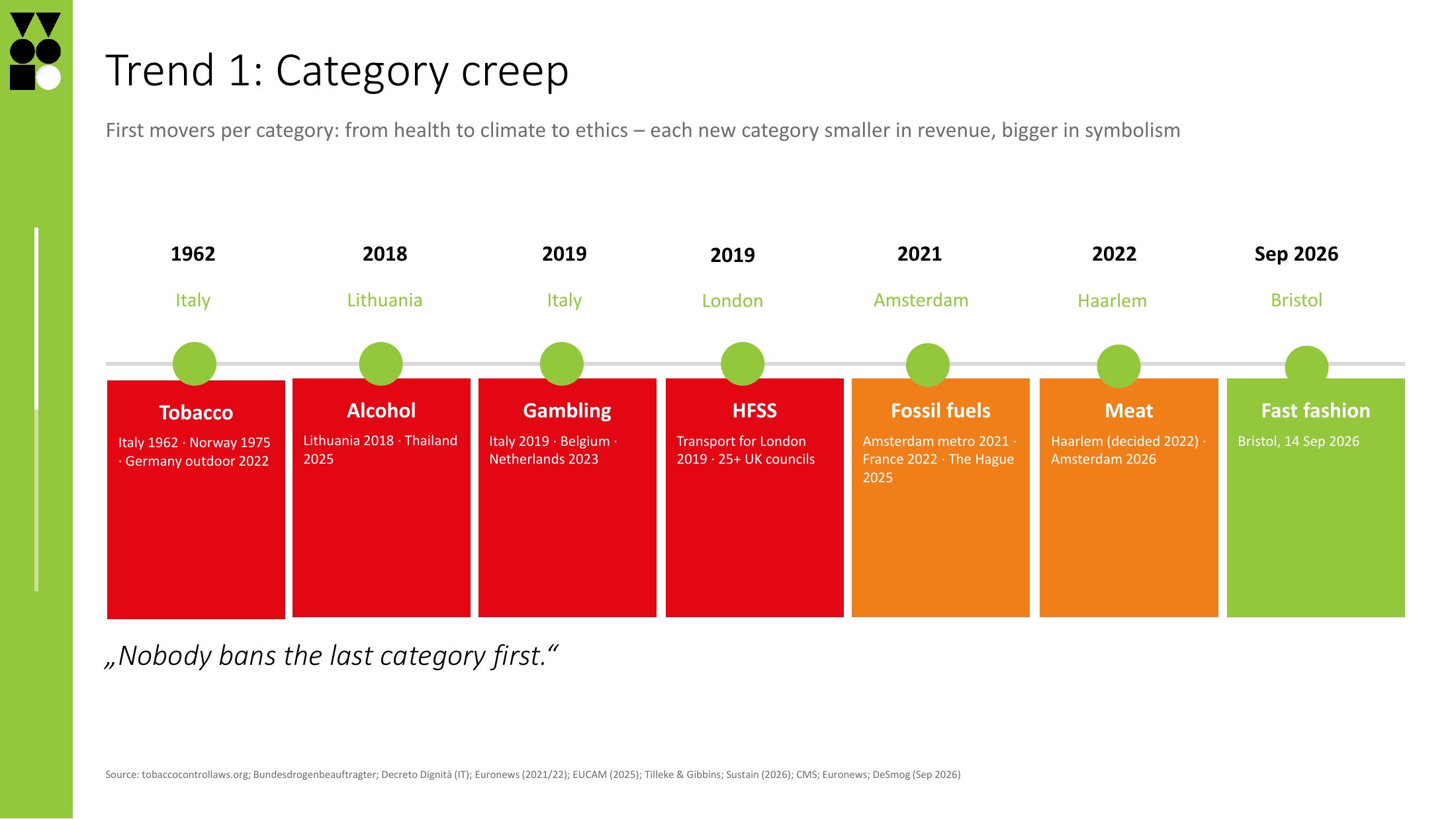 Category creep: each new ban is smaller in revenue and bigger in symbolism. Slide: Kai-Marcus Thäsler
The most radical domino of 2026, Thäsler told the room, did not fall in Amsterdam or Zurich but less than 600 kilometres from Warsaw. Not a product ban, not a city ban, but a whole national Out of Home market redrawn by law in a single summer. He handed over to the man who has lived through it.
Hungary: “This is not regulation. It’s destruction.” 07:17
Tamás Bauer, owner and Managing Director of IK Outdoor and Chair of the OOH section of the Hungarian Advertising Association, called his presentation the anatomy of an industry’s destruction, and the title was not exaggeration.
The road to Hungary’s new law, he explained, began with the previous government’s own use of the medium. Years of aggressive political campaigns on the streets, first against external enemies and from 2024 against the opposition leader Péter Magyar, fuelled public anger towards “posters” in general. When the new government took office, the same omnibus law that banned hate-fuelled propaganda also restricted the formats of commercial Out of Home nationwide, with no impact assessment, and gave local authorities the power to go further. Budapest, which accounts for around 60 per cent of the Hungarian market, did exactly that.
from the law taking effect on 1 October to the deadline for removing sites on 31 December 2026
of billboards removed in Budapest, with 90 per cent gone outside the capital; building wraps and freestanding citylights banned nationwide
media owners expected to go out of business, with around 19,000 people losing site rental income
of Hungarians reject commercial posters; 60 per cent reject hate propaganda and 55 per cent reject political campaigns
What survives in Budapest is a narrow list: citylights and digital citylights inside bus shelters, rooftop advertising, around a fifth of the advertising columns and size-limited vehicle advertising. The remaining digital screens must run static content only, with a minimum spot length of 20 seconds and a mandatory shutdown from 10pm to 6am. The vast majority of surviving sites, Bauer noted, are linked to just two media owners. The government’s stated reasons, he argued, do not survive contact with the evidence.
The justification offered for removing billboards, building wraps and freestanding citylights.
Billboards and wraps are banned, but bus-shelter citylights can stay. The restrictions do not match the argument.
Road safety was cited as a reason for removing roadside formats.
No data was produced linking Hungarian OOH sites to accidents.
Public anger at political propaganda was taken as anger at advertising.
An August 2026 survey found 60 per cent reject hate propaganda and 55 per cent political campaigns, but just 22 per cent commercial posters.
No impact assessment was prepared before the law was passed.
Around 300 companies going bankrupt, some 19,000 people losing income, around 1,200 jobs and roughly HUF 5 billion a year in tax revenue lost.
The money will not stay in the market either. A PanMedia study published on 25 September found that 49 per cent of advertisers plan to cut their Out of Home budgets and 77 per cent will shift spending to social media, which in Hungary is untaxed. Sixty-three per cent say the law makes their business goals harder to achieve.
Bauer was candid about the industry’s own response: silence from other media and from local authorities, and deep-rooted fear among advertisers of challenging politicians’ arguments. His association took the fight to television, radio and the press. And there was, he said, a final irony. The two companies that will survive are Publimont, whose owner has strong ties to the previous government and which displayed 78 per cent of its posters, and JCDecaux.
“If we let toxic politics take over public space, one day there will be nobody left to defend our industry.”
Tamás Bauer, IK Outdoor and Hungarian Advertising Association
Tamás Bauer
Owner and Managing Director / IK OutdoorAn executive with 26 years of experience in out-of-home advertising, Tamás Bauer specializes in the planning, assembly and optimization of OOH campaigns, particularly for major international agencies. His background combines marketing and brand management with long-standing leadership of sales house businesses. Leads a specialist OOH business whose work draws on decades of experience in campaign planning and optimization, supported by a highly skilled, versatile team with extensive market knowledge.
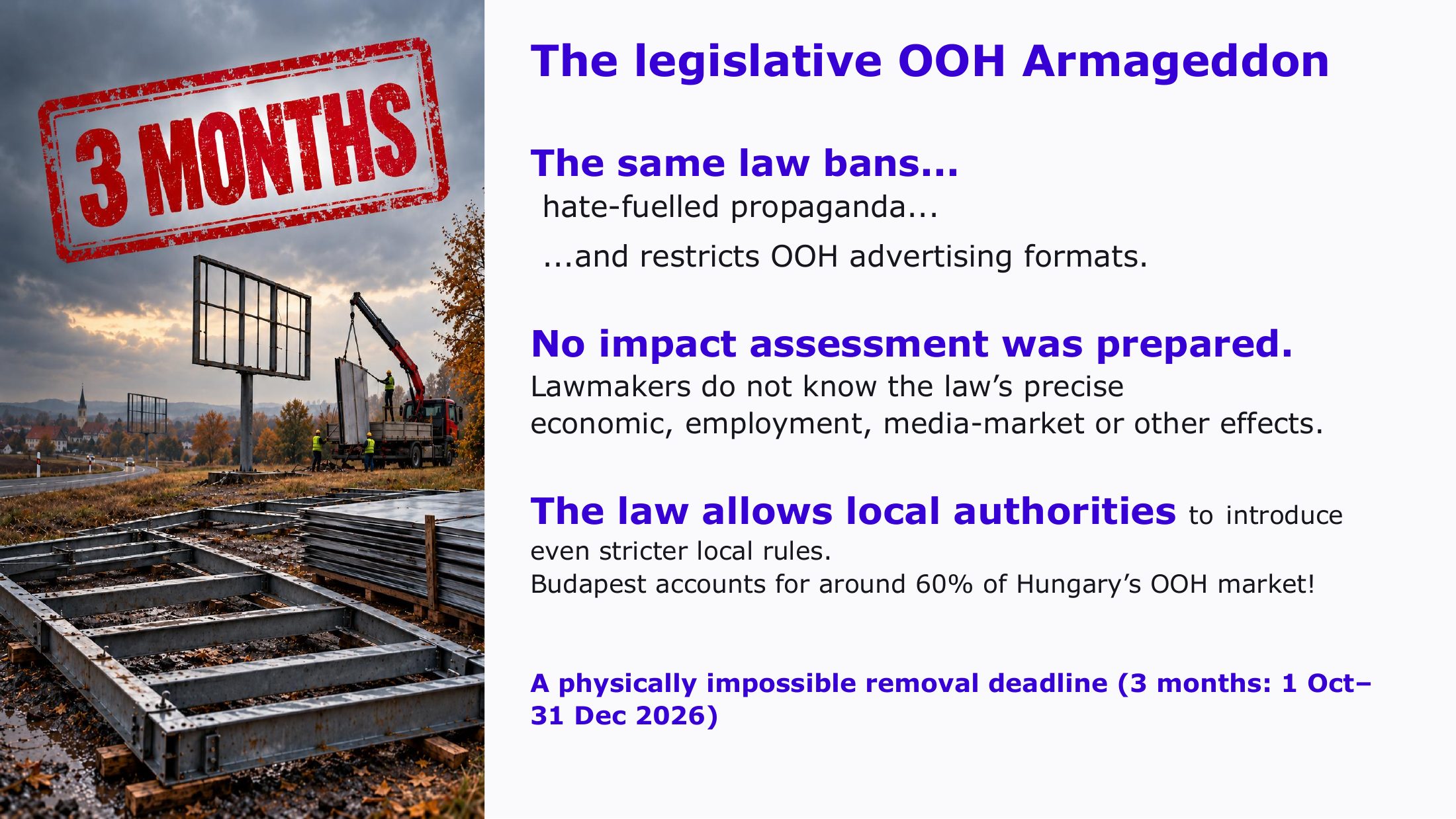 A physically impossible removal deadline, and no impact assessment. Slide: Tamás Bauer
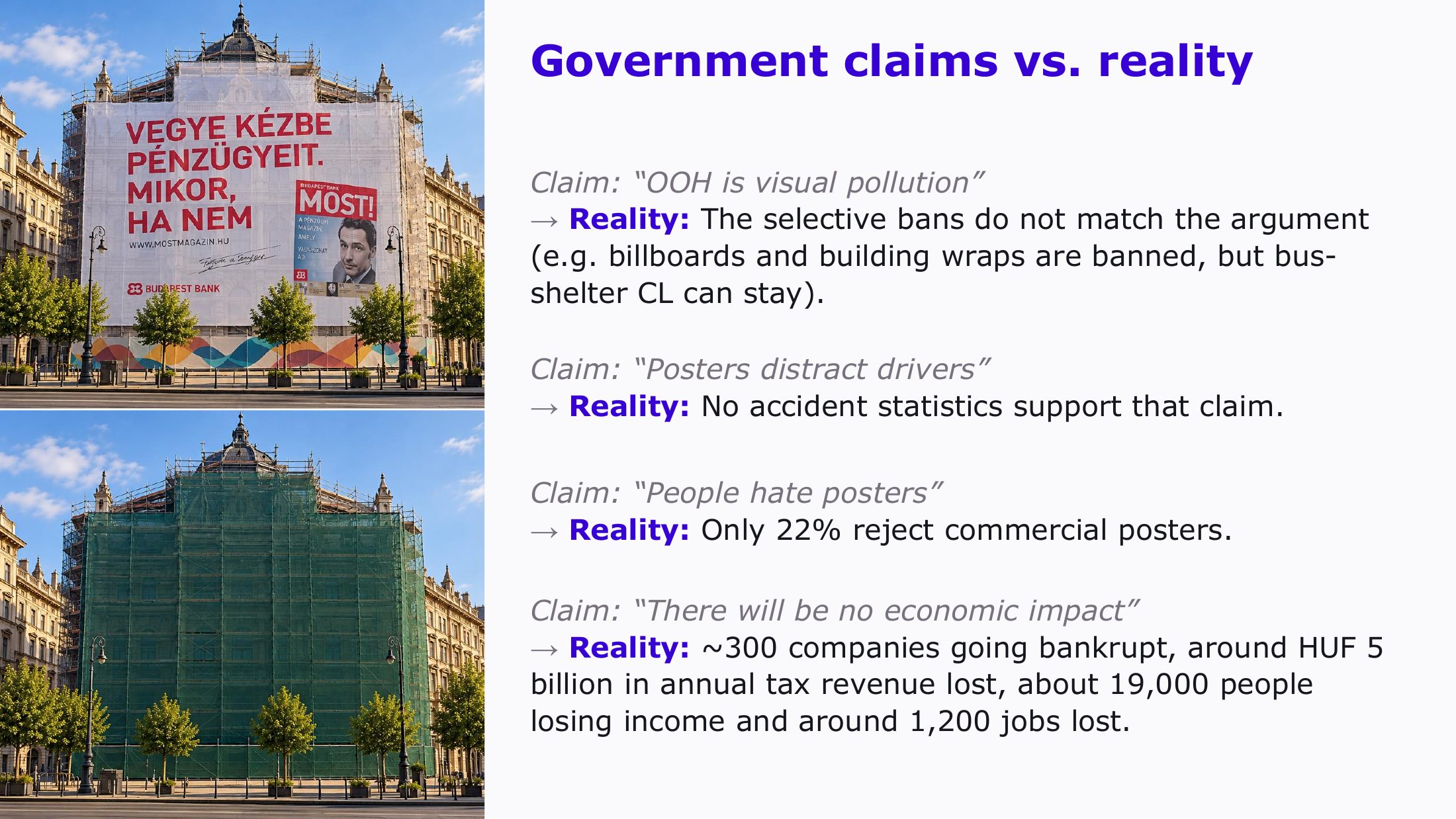 Government claims versus reality. Slide: Tamás Bauer
Stopping the dominoes: what WOO is building 18:36
Thäsler returned to the stage with the second half of his argument: that dominoes can be stopped. Geneva’s voters rejected a “Zéro Pub” initiative; Lyon’s digital ban fell in court; the UK kept Out of Home out of its national HFSS rules; Poland’s Constitutional Tribunal ruled there can be no removal without compensation; and Romania’s gambling-ad ban was watered down in committee. None of that happened by accident.
Regulation is one of WOO’s four workstreams, alongside creativity, sustainability and data, and in twelve months it has gone from a board decision to working infrastructure: a worldwide restrictions database and map, a member survey on product-category restrictions, best-practice documents drawn from Australia, Germany and the UK, an expert pool and a communications toolkit. Next come a Policy Academy and a Global Policy Radar, the early-warning system that scans bills, city resolutions, consultations and court cases in local languages and alerts national associations before a vote rather than after it. “Time is our most valuable resource,” Thäsler said. “Early warning buys us months, not days.”
Five arguments that work
Thäsler also set out the evidence base that national associations can take into any council chamber.
Only 10 per cent of people find Out of Home advertising annoying, against 47 per cent for music streaming and 38 per cent for linear TV (Havas Media Consumer Pulse, 2025).
Five grams of CO₂ per thousand contacts for a small DOOH screen, against 290 for online video, 667 for linear TV and 9,000 for a newspaper.
No significant increase in accidents at digital roadside sites; a minor contribution to urban light pollution, with shop windows the biggest source; fewer than 5 per cent of community complaints in Australia concern OOH.
Official emergency warnings on street screens, media for good, at least EUR 30 million a year guaranteed to Paris from a single street-furniture contract, and Essays for Peace on 120,000 screens in 250 cities.
Real-time information, connectivity and charging, urban sensing, civic communication and publicly funded infrastructure, all financed by advertising rather than the city budget.
The WOO playbook: five principles
Be early, with a radar rather than a fire brigade. Be evidence-led, because internationally comparable research beats national anecdotes. Build alliances across associations, operators, agencies, advertisers and the people who build and maintain the sites. Offer self-regulation before others regulate for you. And protect the industry’s reputation, because content that triggers bans puts everyone at risk. Hungary, he added, is the proof of that last point.
From members, WOO needs four things: feed the radar with every draft law, city resolution and consultation; answer the survey on product-category restrictions; nominate lawyers, researchers and strategists for the expert pool; and use the toolkit.
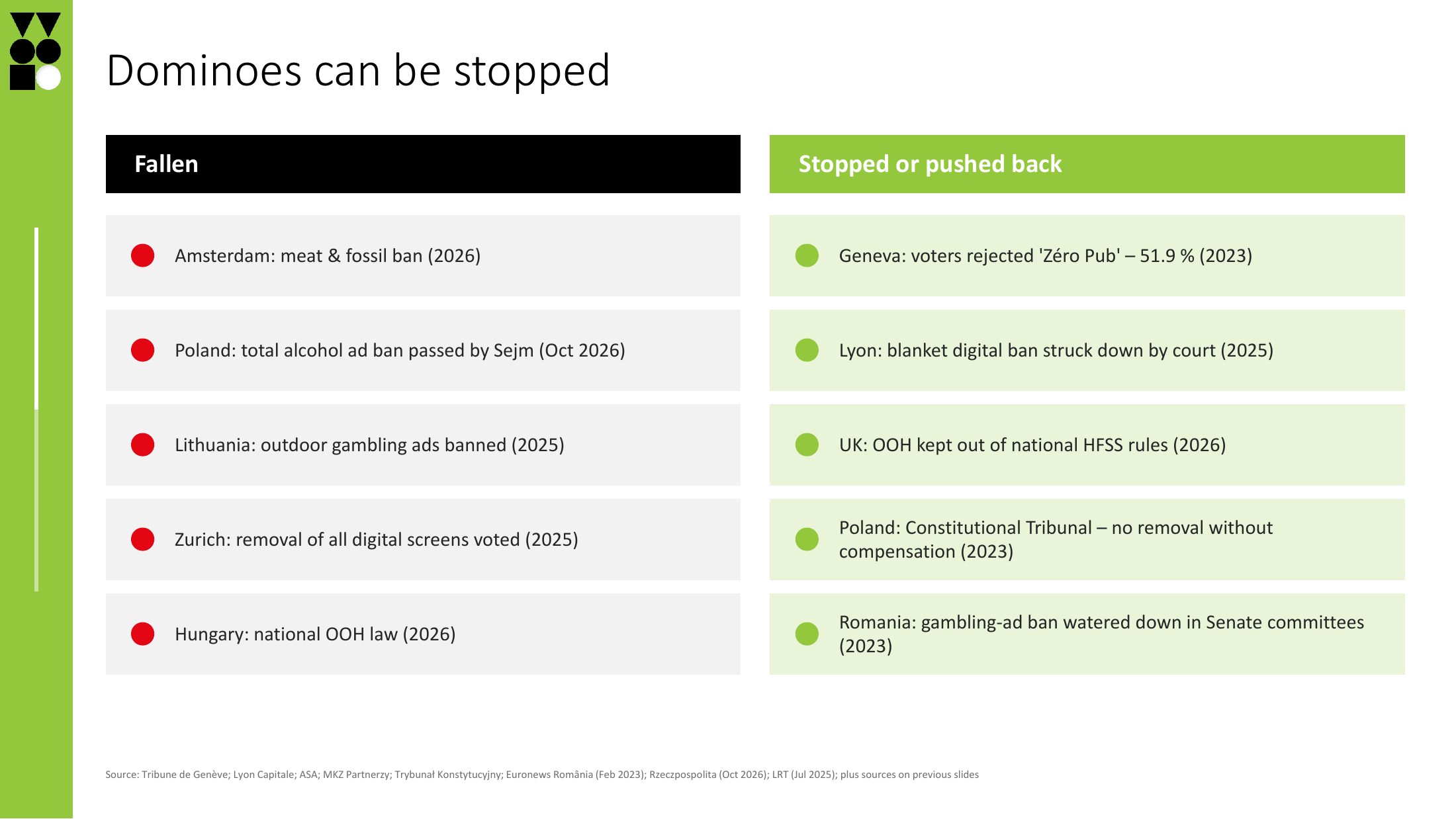 Dominoes can be stopped: Geneva, Lyon, the UK, Poland and Romania. Slide: Kai-Marcus Thäsler
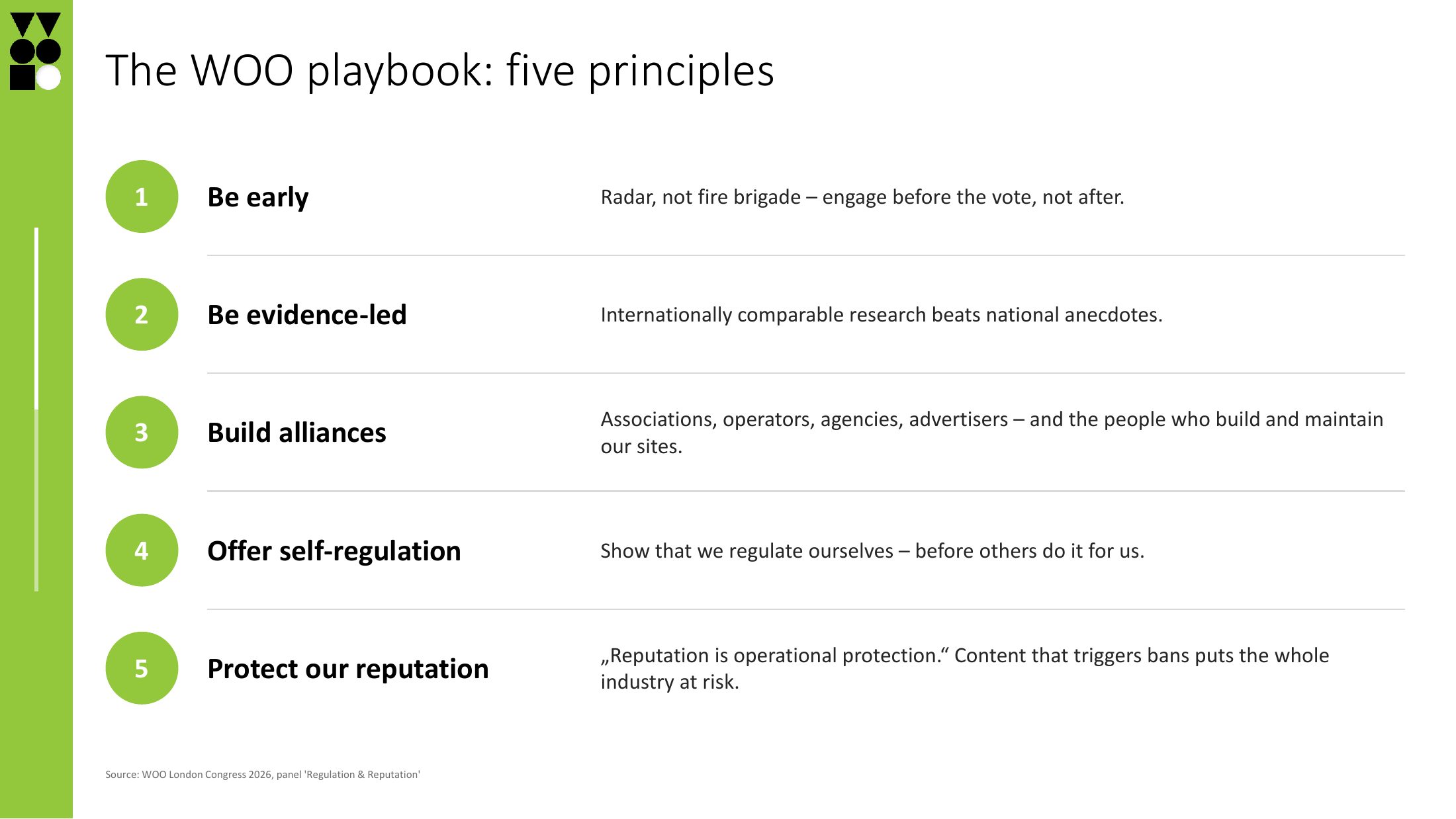 The WOO playbook: five principles. Slide: Kai-Marcus Thäsler
Expert talk: Poland and Austria 32:28
The session closed with two markets where, in Thäsler’s words, the next domino is wobbling, and two leaders with very different stories to tell.

Paweł Orłowski
CEO, Synergic · PolandPoland’s problem, Orłowski explained, has been the absence of regulation rather than its excess. Most Polish cities have had no rules at all, and the result is a visibly cluttered streetscape that makes the industry an easy target. The new “landscape resolutions” now being adopted city by city, including the one under consultation in Warsaw, should bring order: fewer sites, better sites, fair competition between operators and an end to building wraps. His verdict was “less, but better advertising”.
Asked about compensation for removed sites, he said he knew of no cases to date, although Poland’s Constitutional Tribunal has ruled that removal without compensation is unconstitutional. On the measurement side, the Polish industry body OOHlife is tendering a new national audience measurement system, which he sees as essential to making the case for the medium with advertisers and regulators alike.

Andreas Allerstorfer
CEO, AWS Out of Home Media Group · AustriaAustria, by contrast, is heavily regulated across road traffic law, building codes, light emissions and nature conservation, and Allerstorfer, who for years was the voice of outdoor advertisers in the Austrian Chamber of Commerce, argued that the industry has learned to live well with it. The key is a close and continuous dialogue with the cities, which in Vienna goes back to the founding of Gewista by the city itself in 1921. The company is still a third owned by the city, with JCDecaux holding the rest, and has around 70 per cent of the market; EPAMEDIA has a further 25 per cent.
That dialogue is slow but it works. Getting permission for digital screens took from 2015 to 2020, and the industry won it by demonstrating ambient-light sensors that cap luminance at 4,000 nits by day and 200 to 350 at night. When a council in Amstetten tried to go further, the court ruled for the media industry. His message to the room: “We sit in one boat.” Austria’s Outdoor Server audience measurement system, he added, gives the industry the data it needs to prove its value to both clients and cities.
A question from the floor on Italy brought both strands together. Regulation there is centralised in principle, but the regions have begun to act on their own, with Emilia-Romagna moving against digital screens on grounds of light pollution even as a giant LED wall goes up beside Milan’s Duomo. The domino, as Thäsler had said, does not always fall where you expect it.
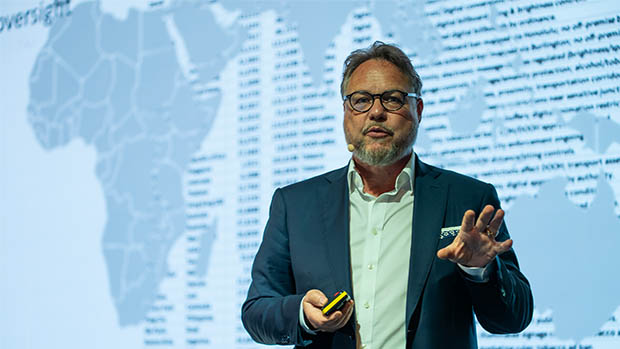
Kai-Marcus Thäsler
WOO Vice-President · Managing Director, Bundesverband Aussenmedien e.V. (FAW), GermanyKai-Marcus Thäsler leads WOO’s regulation workstream and runs the German Out of Home association. Introducing the Warsaw session, WOO President Tom Goddard said he could think of no better guide to the regulatory landscape. The restrictions database, map and toolkit described in this session are available to members at worldooh.org/regulation-and-policy.
Watch the session, use the toolkit
The full regulation session, together with every presentation and panel from Warsaw and the speakers’ slides, is available to WOO members through the WOO Database. Members can also feed the Global Policy Radar and answer the product-category survey from the Regulation and Policy section.
WOO PARTNERSThe organisations powering Out of Home worldwide
Platinum Annual Sponsor





Gold Annual Sponsor

Silver Annual Sponsor


Event Supporters
Event Platinum Sponsor
Event Gold Sponsor
Event Silver Sponsor
Event Sponsor



Event Exhibitor


Media Partners

Supporting Association
AiOO
Platinum Annual Sponsor
AiOO is a global technology company powering the convergence of Digital Out-of-Home and Retail Media, with presence in NYC, Madrid, Dubai, and Casablanca. Our proprietary edge AI and computer-vision technology transforms physical spaces into measurable, addressable media delivering real-time, privacy-by-design audience insights and verified campaign performance.
Built for retailers, media owners, and venue operators, AiOO enables Retail Media networks to monetize in-store traffic with smarter screen planning, audience segmentation, and closed-loop measurement. In parallel, our DOOH stack supports automated operations, holistic ad serving, and programmatic activation—helping partners scale revenue while giving brands and agencies the accountability and precision they expect from digital media.
By bridging the physical world with digital-grade intelligence, AiOO accelerates the shift toward data-driven, performance-ready OOH and Retail Media worldwide.
Website: aioo.tech
LinkedIn: aioo-tech
Instagram: aioo_tech
billups
Platinum Annual Sponsor
billups is an independent global out-of-home (OOH) agency helping advertisers, agencies and OOH media owners strengthen media performance through a patented analytics and measurement platform. With over 20 years of experience and employees spanning 19 countries, their team unites local OOH expertise with global accessibility to actualize international marketing initiatives. billups uses proprietary and patented AI-powered technology to plan, optimize and report on media effectiveness, making OOH an indispensable part of media plans.
Discover how billups is reinventing OOH for the performance age at www.billups.com.
Broadsign
Platinum Annual Sponsor
Broadsign empowers media owners, media buyers, and retailers to harness the power and reach of out-of-home (OOH) to connect with audiences in ways unlike any other advertising channel. More than 2 million static and digital signs along roadways and in airports, shopping malls, grocery and convenience stores, health clinics, transit systems, and more run on Broadsign. The Broadsign Platform helps media owners and retailers, such as Outfront, Pattison Outdoor, Global, oOhMedia!,
Intersection, Sainsbury’s, Woolworths, Stellar Ace, and Douglas, maximize revenue opportunities and automate business operations. It also enables agencies like Talon, OMD Worldwide, Havas, Starcom, dentsu, Omnicom Media Group, and Publicis Groupe to seamlessly plan and execute dynamic OOH campaigns that resonate with audiences. Brands spanning AB InBev, Disney, H&M, Honda, HP, Johnson & Johnson, KLM, Uber Eats, Sea-Doo, Samsonite, and many more have run successful programmatic DOOH campaigns enabled by Broadsign technology.
Daktronics
Platinum Annual Sponsor
Founded in 1968, Daktronics is recognized worldwide as the leading designer and manufacturer of electronic scoreboards, programmable display systems, advertising displays and large screen video displays using LED technology. The company has installed more than 35,000 individual video-capable displays in more than 80 countries around the world and has multiple international manufacturing and office locations. These displays inform and entertain people throughout the world including thousands of digital billboards and many custom Out Of Home digital advertising displays in places like Times Square, New York, and Piccadilly Lights in London. Recently the company installed an 8,000 sq. ft. LED video display system at Rogers Centre, Toronto, Canada.
DynaScan
Platinum Annual Sponsor
DynaScan Technology is a leading manufacturer of outdoor kiosks, high brightness LCDs, dvLED displays, and ePaper signage—delivering premium visual display solutions for retail, smart city, and transportation applications.
Our products are engineered for 24/7 performance in high-ambient light and all-weather environments, offering exceptional visibility and energy efficiency.
From bespoke window-facing displays and weatherproof kiosks to scalable dvLED and ultra-low-power ePaper, DynaScan solutions are trusted worldwide for quality, innovation, and reliability. With offices in the U.S., Europe, and Asia, DynaScan is equipped for global rollouts and support. Learn more at www.dynascan.com.
Media Resources
Platinum Annual Sponsor

Innovating the Future for the Digital OOH Industry
As one of the leading North American LED display companies, Media Resources stands at the forefront of innovation. Our mission is simple: increase the addressable market and ROI for our OOH customers through innovative and leading digital solutions across spectaculars, roadside, airports, transit, and street furniture. At our WOO booth we will demonstrate what we have don’t to accomplish this mission.
As a 60-year-old company operating in North America, our comprehensive expertise spans engineering, design, manufacturing, installation, and service, ensuring that every project is executed to perfection. With the current geopolitical environment and our mastery of the industry in North America it is now time for us to expand our side of North America. We are pleased to be doing that as part of WOO!
If you’re a leading OOH media company seeking impactful advertising solutions to enhance your visibility, Media Resources is here to provide innovative LED display solutions and unparalleled support.
MMG
Platinum Annual Sponsor

Headquartered in the United Arab Emirates, with offices in Abu Dhabi and Dubai, BackLite Media are a specialist Out of Home media company renowned for its innovative approach and commitment to pushing the boundaries of advertising.
As the leading partner with the Roads and Transport Authority (RTA), BackLite Media boasts stand-out locations along the iconic Sheikh Zayed Road. These premier locations, combined with operations in high-profile malls, destinations, and cinema advertising venues, including The Galleria Mall, Al Qana, and Dubai Festival City, position BackLite Media as a key player in delivering unparalleled advertising reach throughout individuals' daily journeys in the UAE.
BackLite Media's success is a testament to its ability to adapt to the dynamic advertising landscape while maintaining a commitment to creativity and innovation as the company continues to shape the future of Out of Home media.
Vistar Media
Platinum Annual Sponsor

Vistar Media is the world’s leading end-to-end programmatic ecosystem for digital out-of-home (DOOH). Vistar Media’s demand-side platform (DSP) and supply-side platform (SSP) empower buyers and sellers to easily transact on DOOH inventory, while applying intelligent data insights that improve media performance. Vistar’s SaaS solutions (unified ad server and Cortex for device and content management) deliver enterprise-grade solutions for monetizing and operating digital signage networks at any scale.
Founded in 2012, Vistar Media is headquartered in New York City and has offices across the United States, Canada, EMEA and APAC. Through its global reach, direct platform integrations, data partnerships, and complete technology stack, Vistar Media continues to power innovation and growth across the digital out-of-home industry.
AllUnite
Gold Annual Sponsor
AllUnite is a global adtech company that specialises in OOH advertising audience measurement and analytics. Its technology provides real-time data on audience behaviour and ad exposure, enabling OOH media owners, advertisers, and agencies to make data-driven decisions and optimise campaign performance.
AllUnite's solutions include digital sensors and holistic data analytics tools. Headquartered in Denmark, and with offices in Italy, and Brazil, AllUnite caters to a diverse clientele across the globe.
BoE
Gold Annual Sponsor
Beijing BOE Sensor Technology Co., Ltd. is one of the four core subsidiaries of BOE Technology Group, which is dedicated to the research, development and industrialization of sensor technologies and solutions. As a key player in the field of high-performance sensors and system solutions, the company focuses on multiple sectors, including consumer electronics, intelligent perception, healthcare, biology, and industry.
Relying on BOE Group's profound knowledge accumulation in the semiconductor display field, the company has deeply integrated diverse sensing technologies to address customers' problems comprehensively. Our highly customized solutions for DOOH (Digital Out-of-Home) customers are meticulously designed to enhance product reliability, enable fault prediction and alarm functions, and significantly reduce equipment maintenance costs.
Contact for more information?zhoujian-hq@boe.com.cn
Moving Walls
Silver Annual Sponsor

Moving Walls is a media technology group with a presence in seven markets across four continents. The group operates a myriad of technology for both the demand and supply sides of Out-Of-Home (OOH). For planners and buyers, Moving Walls operates ‘Moving Audiences’, a patented multi-sensor approach to location-based media measurement like billboards, digital signage, and transit media. For asset owners, the group’s supply-side subsidiary, Location Media Xchange (LMX) is a platform for marketers to profile locations based on the types of audiences around the site and activate mobile and physical place-based media like digital billboards to reach them during this offline journey.
Ipsos
Silver Annual Sponsor

Ipsos - world leader in Out of Home measurement.
Ipsos operates OOH solutions in 17 different countries. (11 recognised industry currencies). We offer the most accurate and reliable insights for media owners, media agencies and brands. People-centric measurement Ipsos provides a total understanding of audiences. Our approach centres around understanding people and is how we build solutions reflective of local environments. We leverage the best in technology, national data sources and our research expertise to deliver realistic representative OOH data for any market need.
Global Expertise Ipsos is present in over 90 different countries. Our local knowledge is supplemented by a central global OOH team which includes the expertise of MGE Data. (OOH Data and Technology specialists who design, develop and manufacture equipment and software.) This mix of global and local expertise enables us to offer tailored contemporary solutions, ensuring our clients have the most accurate datasets for media planning and advertising. We continually invest in our audience measurement capabilities.
Our scale and expertise in data science ensures our tools are future ready. We help our clients to unleash the power of audiences.
Unilumin Group
Silver Annual Sponsor
Unilumin, is the LED application pioneer, established in 2004, providing professional LED application services, including the world's leading LED display and lighting products and Metasight solutions. The company was listed on the Shenzhen Stock Exchange in 2011 (XSHE: 300232) and has consistently been leading in LED display industry exports for 8 consecutive years, earning the trust and support of customers worldwide.
“21th anniversary is a milestone moment for Unilumin in 2025, representing that Unilumin has led the field in stably, maturely, competitively. Looking forward to the future, Unilumin will steadfastly work with partners to formulate more specific goals and prepare for the next more years of development.
Learn more: www.unilumin.com
VIOOH
Silver Annual Sponsor
VIOOH is a leading premium global digital out of home supply-side platform that connects buyers and sellers in a premium marketplace, making OOH easily accessible.
Led by a team of digital OOH and programmatic tech experts, VIOOH is pioneering the transformation of the OOH sector, championing its role in enhancing omni-channel digital campaigns through the use of programmatic capabilities and data. VIOOH currently trades programmatically in 22 markets and provides access to inventory from some of the world’s top DOOH media owners, including APG, Branded Cities, Framen, In-store Media, JCDecaux, Media Frankfurt, Media Transports, and more.
For more information about VIOOH, please visit www.viooh.com or follow us on X (Twitter) and LinkedIn.
AMS Poland
Event Platinum Sponsor
AMS is Poland’s market leader in out-of-home (OOH) advertising and one of the country’s most awarded media operators. Part of Agora Group since 2002, AMS delivers classic and digital OOH solutions through a portfolio of nearly 23,000 advertising assets across all market segments. Reaching more than 27 million audience contacts every month, the company connects brands with consumers in cities, transport networks, shopping centres and public spaces nationwide.
AMS is also Poland’s market leader in urban furniture, having developed and maintained advertising-funded infrastructure in over 30 major cities. Through innovation, technology and long-term partnerships with municipalities, AMS continues to shape the future of the Polish OOH market today.
ALMA
Event Gold Sponsor
Alma is Georgia's leading out-of-home media company, operating the country's largest OOH network: billboards, digital screens, city formats including bus shelters and lightboxes, plus metro, buses and international airports. With in-house printing, installation and maintenance, Alma delivers end-to-end campaigns, while its audience measurement and AI-powered sales platform bring data-driven planning to the market.
Founded in 1995 and headquartered in Tbilisi, Alma also shapes the city itself, building modern bus stops and accessible pedestrian bridges across the capital. With three decades of experience and continued investment in technology, Alma leads the growth of OOH at the crossroads of Europe and Asia.
Bauer Media Outdoor Poland
Event Silver Sponsor
Bauer Media Outdoor Poland is part of Bauer Media Group, one of Europe’s largest media groups, and a leading provider of OOH and DOOH advertising solutions in Poland.
Its comprehensive portfolio spans traditional outdoor formats, digital screens and transit advertising. Bauer Media Outdoor Poland operates a network of nearly 6,000 Out-of-Home (OOH) advertising sites across 18 urban areas in Poland, offering advertisers extensive reach and multiple ways to connect with audiences in urban environments.
As a pioneer in the development of Digital Out-of-Home (DOOH) advertising in Poland, Bauer Media Outdoor combines an extensive media network with innovative technology and data-driven solutions. From campaign planning and execution to advanced measurement and performance analysis, the company empowers advertisers to make informed decisions and maximise campaign effectiveness.
Silverflow OOH
Event Silver Sponsor
Re-defining real-world brand connections
Silverflow OOH is an independent international Out of Home specialist agency, helping brands and media agencies plan, buy and deliver effective OOH campaigns across global markets.
Founded by industry veterans Adrian Skelton and Winfried Karst, Silverflow OOH brings together decades of international OOH experience with a fresh, entrepreneurial approach to delivering outstanding client service, innovative solutions and commercial value.
With employees in Frankfurt, London and Milan, and an expanding network of vendor & specialist partners worldwide, Silverflow OOH combines global reach with deep local market knowledge, providing clients with a seamless, centralised approach to international OOH planning and execution.
At the heart of Silverflow OOH’s proposition is the belief that the future of Out of Home lies in combining human expertise, creativity, data and technology. Through its suite of proprietary solutions, including SilverSync, SilverOptimal, SilverCreate and SilverAI, the agency is helping clients unlock new opportunities in audience targeting, programmatic DOOH, creative optimisation and campaign effectiveness.
As an active member of the World Out of Home Organization (WOO) and DPAA, Silverflow OOH is committed to supporting the continued growth, innovation and international development of the OOH industry.
Driven by its founding principles of Experience, Quality & Trust, Silverflow OOH’s ambition is to become the independent international OOH partner of choice, connecting brands with audiences through powerful, relevant and memorable experiences in the real world.
ALL UNITE
Event Sponsor
AllUnite is a global adtech company that specialises in OOH advertising audience measurement and analytics. Its technology provides real-time data on audience behaviour and ad exposure, enabling OOH media owners, advertisers, and agencies to make data-driven decisions and optimise campaign performance.
AllUnite's solutions include digital sensors and holistic data analytics tools. Headquartered in Denmark, and with offices in Italy, and Brazil, AllUnite caters to a diverse clientele across the globe.
BLOW-UP MEDIA
Event Sponsor
blowUP media, part of the Ströer Group, has been an international expert in premium large-format outdoor advertising for over three decades. From Giant Posters and Digital Screens to Traffic Towers on Germany's busiest motorways, blowUP media is represented in Germany, the UK, the Netherlands, and Belgium. With around 300 (D)OOH locations, we offer the largest network for large-scale advertising media in Europe. With sizes up to 3,000 m², we make brands unmissable and reach urban target groups in Europe's major cities. Our innovative Special Builds and creative solutions allow brands to connect authentically with consumers, creating engaging brand experiences that are long remembered. blowUP media's expertise in premium advertising sites also enables us to assist building owners, including local authorities and heritage sites, by creatively wrapping buildings during renovation works.
We combine high-impact (D)OOH advertising solutions with a continuous focus on reducing environmental impacts where possible. Our portfolio includes PVC-free and recycled materials, upcycling and recycling concepts, Vertical Gardens®, renewable electricity, CO₂e footprint assessments, and collaborations with sustainability partners. Through ongoing optimisation of our products and processes, we support both our own sustainability objectives and those of our clients. We also seek to contribute to the broader development of more responsible practices within the out-of-home advertising industry.
More information is available at https://www.blowup-media.com/
Broadsign
Event Sponsor
Broadsign empowers media owners, media buyers, and retailers to harness the power and reach of out-of-home (OOH) to connect with audiences in ways unlike any other advertising channel. More than 2 million static and digital signs along roadways and in airports, shopping malls, grocery and convenience stores, health clinics, transit systems, and more run on Broadsign. The Broadsign Platform helps media owners and retailers, such as Outfront, Pattison Outdoor, Global, oOhMedia!,
Intersection, Sainsbury’s, Woolworths, Stellar Ace, and Douglas, maximize revenue opportunities and automate business operations. It also enables agencies like Talon, OMD Worldwide, Havas, Starcom, dentsu, Omnicom Media Group, and Publicis Groupe to seamlessly plan and execute dynamic OOH campaigns that resonate with audiences. Brands spanning AB InBev, Disney, H&M, Honda, HP, Johnson & Johnson, KLM, Uber Eats, Sea-Doo, Samsonite, and many more have run successful programmatic DOOH campaigns enabled by Broadsign technology.
GIMC
Event Sponsor
GIMC was founded in 1979 as one of the earliest advertising agencies in China. Today, it stands as one of the strongest marketing groups in the country, headquartered in Guangzhou, China. Committed to the philosophy of "creating value for clients," GIMC provides professional marketing services to over 300 renowned companies worldwide. In 2010, GIMC was listed on the Shenzhen Stock Exchange (Stock Code: 002400), becoming the "first advertising and marketing stock in China."
GIMC has more than 60 member companies, with annual operating revenue exceeding RMB 20 billion and total assets surpassing RMB 10 billion. Its service network covers all major regions of China. In 2016, GIMC became the first marketing group to be included in the Fortune China 500. In 2018, it received the "National May Day Labor Award," the only marketing group ever to receive this prestigious national honor. In 2024, GIMC was designated a "National Advertising Industry Park," setting a benchmark for national-level innovation in the advertising industry.
GIMC offers full-service capabilities, providing over 300 clients worldwide with one-stop, full-marketing solutions, including brand management, media agency, digital marketing, and cross-border marketing. It has developed a portfolio of digital and intelligent marketing products, including GIMC Cloud, Lingxi AI, and Jingpeng Ad Delivery, providing smarter, personalized big-data solutions to meet diverse client needs. In 2024, it was recognized as the Guangdong Provincial Engineering Technology Research Center for Performance Marketing.
Over 47 years, the trust of clients and the baptism of the market have fueled GIMC's surging momentum in innovation, creating a development miracle in the history of Chinese advertising. GIMC will continue to pursue excellence, drive holistic growth through intelligent marketing, lead the transformation of the intelligent marketing industry, promote Chinese brands worldwide, and continuously create value for shareholders, clients, and employees, striving to become an outstanding global intelligent marketing group.
Moving Walls
Event Sponsor
Moving Walls is a media technology group with a presence in seven markets across four continents. The group operates a myriad of technology for both the demand and supply sides of Out-Of-Home (OOH). For planners and buyers, Moving Walls operates ‘Moving Audiences’, a patented multi-sensor approach to location-based media measurement like billboards, digital signage, and transit media.
For asset owners, the group’s supply-side subsidiary, Location Media Xchange (LMX) is a platform for marketers to profile locations based on the types of audiences around the site and activate mobile and physical place-based media like digital billboards to reach them during this offline journey.
Outdoorlink
Event Sponsor
Outdoorlink is a leading provider of remote device management solutions for the Out-of-Home (OOH), Digital Out-of-Home (DOOH), and Retail Media industries. Founded in 2007, our agnostic, cellular-based hardware enables real-time monitoring, alarms, troubleshooting, and remote management of billboard lighting and digital displays, helping operators maximize uptime, reduce maintenance costs, and improve operational efficiency.
Outdoorlink supports one of the largest connected OOH networks in the world, with more than 100,000 controllers across 25+ countries, supporting over 150,000 static illuminated faces and 15,000+ digital faces on our platform.
With a growing international footprint and an expanding product portfolio, we deliver reliable, scalable technology that powers the next generation of out-of-home media.
RETARGETING OOH
Event Sponsor
We're the global range provider of OOH retargeting digital campaigns. If you are investing in OOH campaigns, we can increase their effectiveness by sustaining contact with the OOH campaign audience when they escape the OOH vehicles range. Continue your campaign communication to your OOH audience with display or video formats. Redirect their interest to the landing page and convert them into clients.
SCREEN NETWORK
Event Sponsor
Screen Network is Poland’s leading Digital Out of Home (DOOH) company, operating the country’s largest network of over 20,000 screens. Its portfolio combines spectacular large-format LED displays in major city centres with screens in railway stations, shopping malls and fitness clubs nationwide.
Its latest landmark project, Warsaw Stage, is Europe’s largest 3D LED screen, spanning over 800 m² and reflecting its commitment to pushing the boundaries of DOOH. The company is also known for award-winning campaigns and its involvement in social and educational initiatives.
Screen Network and Braughman, a specialist in premium large-format OOH advertising, are both part of Digital Network Group, which is listed on the Warsaw Stock Exchange.
Absen
Event Exhibitor
Established in 2001, Absen (SZSE: 300389) is the world's leading LED display products and service supplier. Absen’s products are exported to 165 countries and regions in America, Europe, Australia, Asia, Africa, etc., and have been used in the Presidential press conference, CIIE, FIFA World Cups, NBA games and Times Square.
Delivering more than 65,000 installations, Absen produces best in class products for DOOH , rental & staging , commercial display , data visualization, conference display and consumer markets, with the export volume of LED products being NO.1 for 16 consecutive years.
BOE TEC
Event Exhibitor
Beijing BOE Sensor Technology Co., Ltd. is one of the four core subsidiaries of BOE Technology Group, which is dedicated to the research, development and industrialization of sensor technologies and solutions. As a key player in the field of high-performance sensors and system solutions, the company focuses on multiple sectors, including consumer electronics, intelligent perception, healthcare, biology, and industry.
Relying on BOE Group's profound knowledge accumulation in the semiconductor display field, the company has deeply integrated diverse sensing technologies to address customers' problems comprehensively. Our highly customized solutions for DOOH (Digital Out-of-Home) customers are meticulously designed to enhance product reliability, enable fault prediction and alarm functions, and significantly reduce equipment maintenance costs.
Daktronics
Event Exhibitor
Founded in 1968, Daktronics is recognized worldwide as the leading designer and manufacturer of electronic scoreboards, programmable display systems, advertising displays and large screen video displays using LED technology. The company has installed more than 35,000 individual video-capable displays in more than 80 countries around the world and has multiple international manufacturing and office locations. These displays inform and entertain people throughout the world including thousands of digital billboards and many custom Out Of Home digital advertising displays in places like Times Square, New York, and Piccadilly Lights in London. Recently the company installed an 8,000 sq. ft. LED video display system at Rogers Centre, Toronto, Canada.
GRUPA MTP
Event Exhibitor
City Marketing (part of Grupa MTP) is an OOH advertising company managing nearly 1,000 structures in Poznań, Kołobrzeg, and Świnoujście. Its portfolio includes citylights, backlight billboards, motorway megaboards, airport ads, and a spectacular 212 sqm LED screen at the MTP fairground near Poznań’s main railway station and one of its key transit hubs. It is a member of the OOHlife chamber.
Its parent company, Grupa MTP, is a leading Polish trade fair organiser managing MTP Poznań Expo, Poznań Congress Center, Wola Hippodrom, and Targi Lublin. It offers comprehensive event services, including stand construction, catering, and online marketing.
LDSK / SAMSUNG
Event Exhibitor
Enhance your campaign planning with intelligent tools that complement traditional slots and loops. Go beyond the limitations of conventional scheduling, automate workflows, schedule smarter, and earn more. LDSK leverages audience profiles, shopper data, and operational data to inform scheduling decisions and automate workflows, freeing your team from manual tasks.
With LDSK, you can:
* Sell smarter: Offer highly targeted, premium-priced campaigns.
* Optimise screen time: Ensure every second earns its keep.
* Increase revenue: Unlock your network's full potential.
LDSK is a technology partner for media owners, integrators, and any supply-side partner looking to add value to their ecosystem.
Ready to schedule smarter and earn more? Get in touch with us.
Our platform powers smart media owners with:
- Connections for programmatic, automated and manual trading
- Flexible content management and automated scheduling
- Intelligent Optimization for revenue generation
- White-label e-commerce for direct sales
Explore more at www.ldsk.io
OOH Mgazine
Media Partners
OOH magazine is a leading trade publisher based in Katowice, Poland, specializing in the advertising, marketing, print, and promotional products industries. History and Profile • Founded: Established in 2005, the private company has grown to become a prominent voice in the Polish advertising sector. • Focus Areas: Covers trends and news across Marketing Mix, Trade Marketing/POS (Point of Sale), Promotional Gadgets, Event Mix, and Media & Machines. • Target Audience: Reaches corporate marketing departments, small and medium enterprises (SMEs), advertising and PR agencies, and POS/print producers. Key Activities and Events • Trade Publications: Publishes regular digital and print editions, including specialized issues tied to major industry catalogs and trade shows. • Event Organization: Organizes major industry trade fairs such as Festiwal Marketingu and PROMO SHOW. • POS STARS Competition: Hosts an annual competition recognizing the best advertising displays and POS materials across nearly 20 diverse categories.
OOH Life
Supporting Association
A platform for sharing information and education about the OOH industry. Its aim is to promote and educate on the new trends emerging as technology develops, to spread good practice and to inspire the people who create communications.
It is organised by the Outdoor Advertising Chamber of Commerce (Izba Gospodarcza Reklamy Zewnętrznej OOH), which has been working on behalf of Out of Home media for twenty years. As the Chamber is a member of WOO, the international organisation for the industry, it has access to knowledge and the most interesting case studies from around the world. We want to inspire and contribute to the creation of well-designed, innovative and engaging OOH messages. It is a unique medium because it is the most democratic medium of communication.
It is also often used in social and cultural campaigns. What is more, with an unconventional, creative approach it offers the chance to make a huge impact, creating an opportunity to generate buzz online and on social media. The platform also aims to bring the OOH industry together, addresses topics specific to it alone, and makes its voice stronger.