Retail Media · WOO Insight
In-Store Retail Media: Time to Close the Loop
Hammad Benjelloun, Founder & CEO of AiOO, on why physical retail media has been stuck, and what it takes for in-store screens to behave like the rest of the retail media stack.
Retail media has become the third great wave of digital advertising, alongside search and social. But almost all of that growth has happened online. The screens and the customer audiences inside the world’s stores, where most retail commerce still happens, have been left out of the conversation.
WOO sat down with Hammad Benjelloun on why in-store has lagged, and why the next era of retail media will be defined not by sponsored listings online, but in-store audiences and the measurable outcomes they drive at the till.
Retail media is the fastest-growing advertising category in the world. Why has in-store been so slow to mature?
The category has been built on a fundamental mismatch. 80% of consumer spending happens in physical stores, yet 90% of retail media budgets go online. In-store is the single fastest-growing subsegment, projected to grow at a 30.1% compound annual rate through 2028, nearly twice the pace of retail media overall. The gap is an infrastructure problem the industry has not confronted.
Online retail media works because every part of the chain is measurable, predictable and repeatable. In-store has had none of that. Screens have existed in retail for years, but they have largely operated as digital signage — beautiful, but blind. No audience signal. No real-time delivery. No connection to the till. When a brand asks what their in-store campaign actually did, the honest answer most networks can give is “we estimated it.” That is not retail media. That is a poster with a screen behind it.
Screens have largely operated as digital signage — beautiful, but blind. No audience signal. No real-time delivery. No connection to the till.
What is still missing?
Three things, and they have to come together.
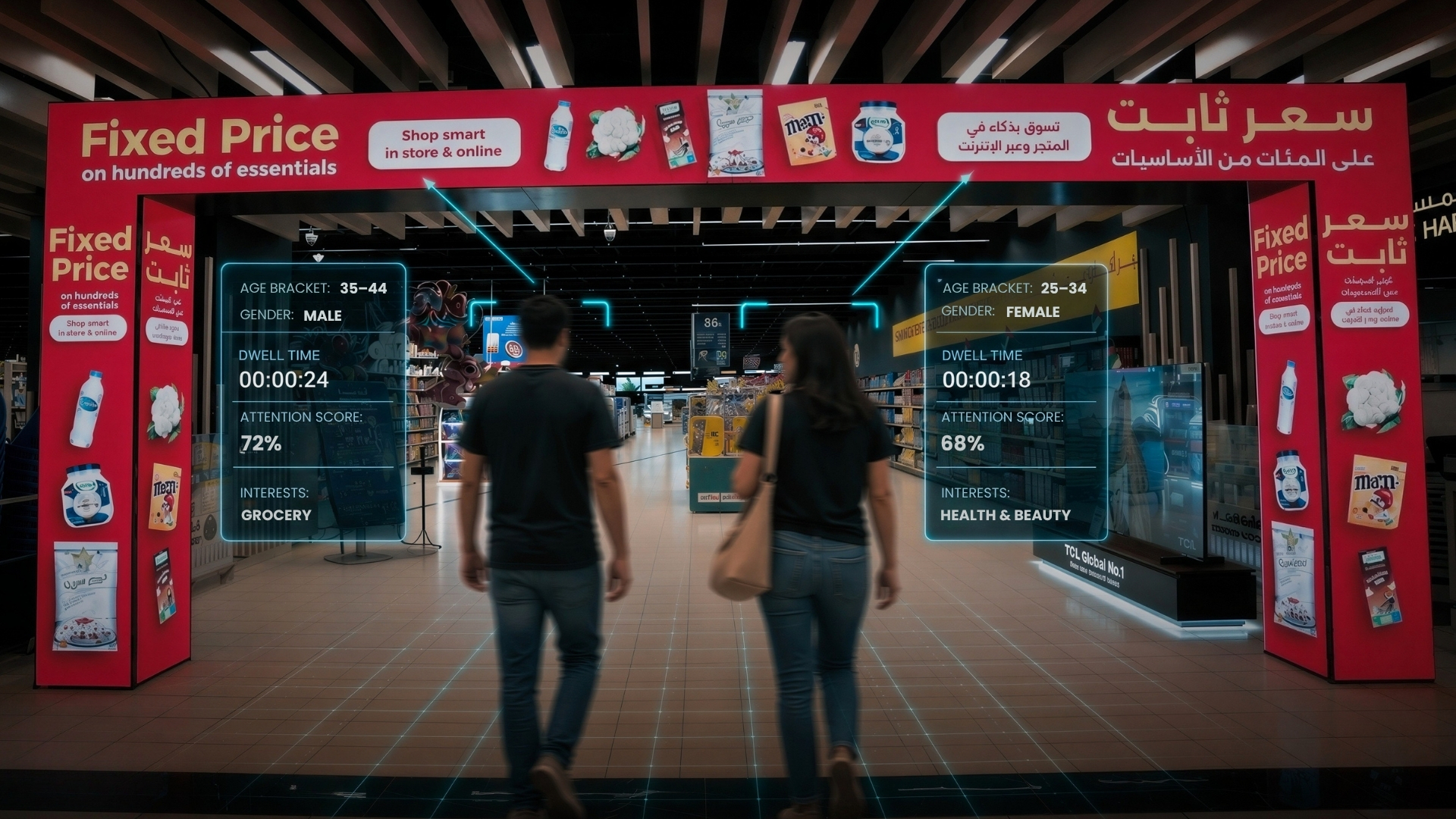
First, audience signals that feed campaign delivery algorithms in real-time. Not estimated footfall counted at the door, but actual, anonymous, in-aisle audience composition the moment a screen is about to play an ad.
Second, real-time activation at the impression level. Most networks still get this wrong. They swap creative based on weather or time of day and call it audience activation. True audience activation goes a step further. It combines collected in-store behavioural data with the retailer’s first-party data to decide, in real time, which campaign to serve to the audience standing in front of the screen: optimised for sales uplift, not just exposure. That is the same logic that runs every programmatic auction online.
Third, closed-loop attribution against POS data. Did the people exposed to the campaign actually buy? Not modelled, not survey-reconstructed after the fact — matched. This is where AiOO has taken a different architectural decision from the rest of the category. We’ve built all three of these capabilities: the audience signal, real-time impression-level activation, and POS-matched attribution, into a single stack, running direct and programmatic campaigns activated by the same live audience signal. We call it the real-time retail media stack. The mechanism is simple to describe and hard to retrofit: anonymous audience detection at the screen, exposed versus non-exposed cohort analysis against SKU-level POS data, and uplift measured on the same platform that delivered the campaign. Every impression ties to a transaction. The reason most in-store networks cannot do this is not commercial, it’s architectural. Real-time has to be in the foundation from day one. It cannot be bolted on top of a legacy playlist system.
Online retail media is built on rich audience segments. Can in-store match that?
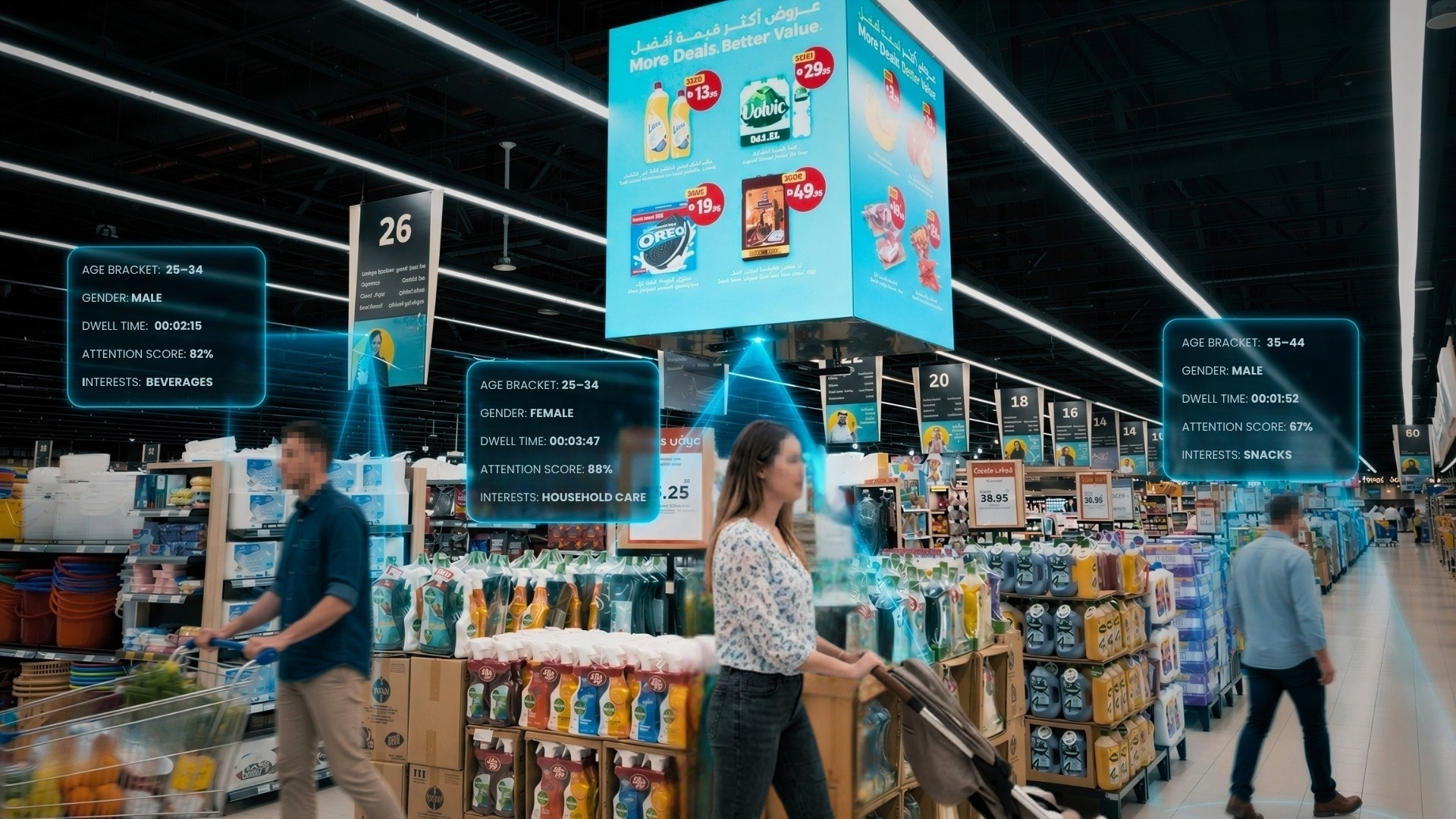
In some ways, in-store goes further than online. Online segments are built on declared and behavioural data, what someone clicked or searched. A physical store gives you something different and arguably more valuable: real, observed, in-the-moment behaviour. The shopper who pauses in the dairy aisle for forty-five seconds is showing intent no click can replicate. You can identify frequent buyers anonymously, by recurring presence patterns, without ever needing to know who they are.
Then layer journey on top. Where someone enters, where they pause, where they convert. That path through the store is itself a targeting dimension.
And those signals don’t have to stay in the store: feeding them into the retailer’s CDP closes a gap that today goes dark the moment a customer walks in, giving the retailer a unified customer view no other source can build.
The physical store is not a lower-resolution version of online.
It is a different and complementary signal layer.
You mentioned attribution as the unlock. What does the industry need to get right?
We need to stop confusing post-mortem measurement with attribution. The industry has spent a decade counting proxies: estimated impressions from sensor-based footfall, modelled reach extrapolated from panel data, and brand lift surveys run weeks after a campaign ends. That is not what brands are buying. Brands invest in outcomes. Closed-loop attribution means three things: an exposed cohort identifiable anonymously, transactions matched against POS records at SKU level, and a control group against which uplift can be measured accurately on the same platform. Without all three, you have a story, not a number.
Where does this take the OOH industry over the next three to five years?
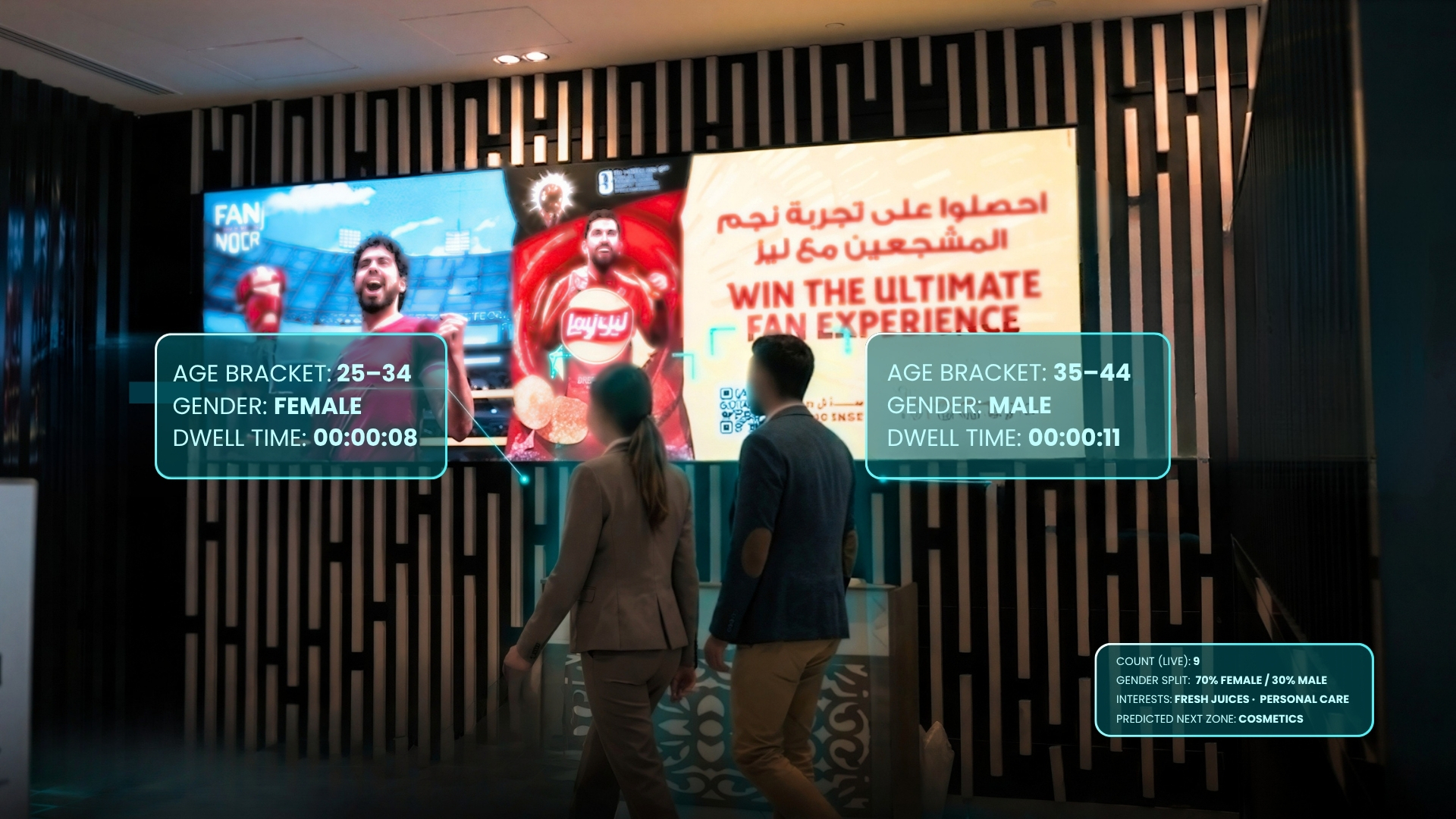
Back into the centre of the conversation. For years, OOH has been treated as an upper-funnel channel. That is no longer true. Once you can link a screen to an audience segment and a transaction, the whole industry moves into performance territory. The retail store is the proving ground, but the same closed-loop infrastructure extends across the wider DOOH ecosystem: mall screens, transit hubs, airports. Any environment where audiences can be detected and outcomes can be matched becomes performance media.
And it goes further. Within three to five years, the most valuable in-store screens will not be selling impressions traditionally. They will be real-time decisioning nodes, aware of the stock behind them, the audience in front of them, the price the brand will pay, and the outcome at the till. Every screen, indoor or outdoor, will be addressable, accountable, and connected to an outcome, or it will not be sold.
We’re building toward that future at AiOO, but no company will build it alone. The next era of retail media, the in-store era, is one the entire OOH ecosystem has the right to win, if we move with ambition.
The retail store is the proving ground. But the same closed-loop infrastructure extends out into the other DOOH environments. And that is the bigger prize.