The Show Goes On
How the Ukrainian OOH market adapted, recovered and kept evolving
In one of the most compelling sessions of the WOO Central European Forum, Viktor Ivanchenko of Advertising Holding Megapolis+ described how Ukraine’s Out of Home industry lost more than half its value in a year, rebuilt its measurement from scratch, followed its audiences across a changed map, and is now bigger than it was before the war. Watch the full presentation below.
Ivanchenko opened with a simple framing for a room of European OOH leaders: cities like yours, a neighbour unlike yours. The images that followed, of screens shredded by blast waves and billboards standing in front of shelled apartment blocks, made the point that what he was about to describe happened in a market that looks, in every other respect, much like the ones his audience work in.
What followed was not a story about damage. It was a methodical account of how a market responded to each problem the war threw at it, with a figure attached to every claim.
A market that halved, then recovered
Ukraine’s OOH market was worth EUR 127 million in 2021. In 2022 it fell to EUR 52 million. It has grown every year since: EUR 82 million in 2023, EUR 106 million in 2024, EUR 125 million in 2025 and a forecast EUR 133 million for 2026, above the pre-war level.
Ukrainian OOH market, 2021
2022, the first year of full-scale war
2025
2026 forecast, above pre-war
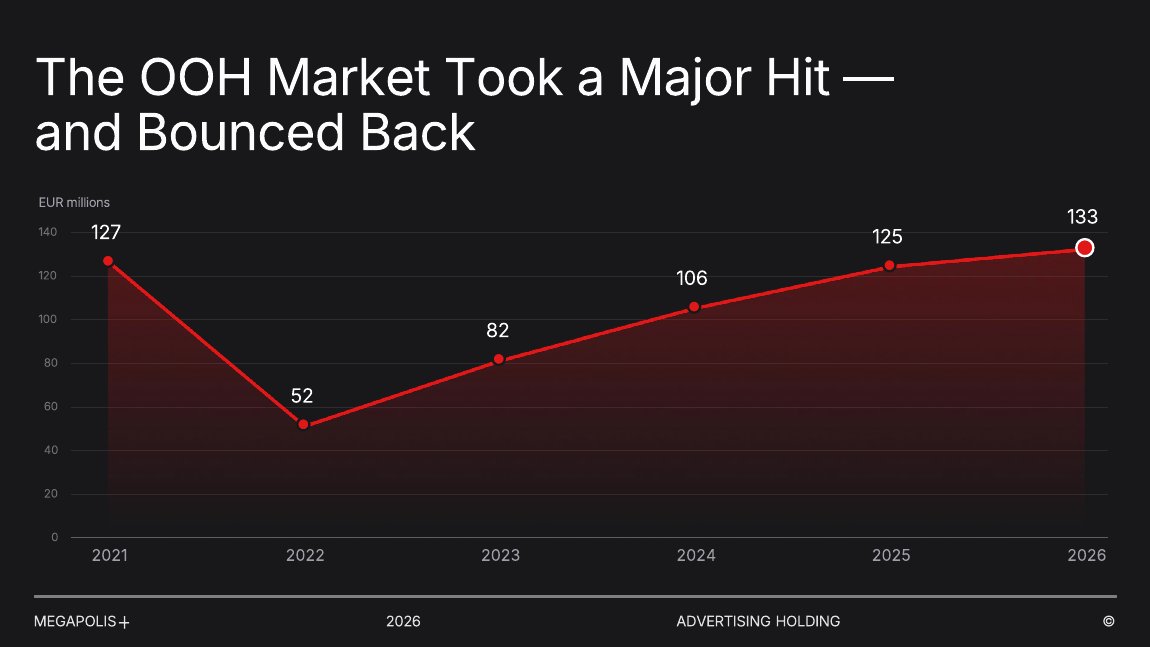 The market took a major hit and bounced back. Source: Megapolis+
Four challenges, four responses
The structure of the talk was a sequence of challenge and response. Each problem the war created for the medium was met with a specific decision by the business, and Ivanchenko showed what each one produced.
Millions were displaced internally and millions more left and returned. Kyiv took 21% of returnees, Dnipro 10%, Odesa 9%. Traffic rose 37% in Chernivtsi and fell 38% in Sumy. The audience was no longer where the inventory was.
Business activity and demand for OOH shifted with the population, and Megapolis+ rebalanced its network and sales effort city by city to match, using traffic data rather than pre-war assumptions.
Before the war, advertisers and agencies relied on a single system of OOH monitoring, ratings and industry benchmarks. It ceased operations, leaving the market without a common measurement framework.
Monitoring restarted in March 2023: 15 cities tracked monthly with more than 90% inventory coverage, audience ratings (OTS, GRPs) rebuilt for 21 cities from new vehicle and pedestrian traffic data, and Kyivstar mobile Big Data layered on top to show where people now live, work and move.
Urban space filled with commercial, public service and military recruitment advertising at once. Presence alone was no longer enough; brands needed to stand out, and to update messages faster, with more creative variations.
Investment in large-format digital screens in city centres, business districts and landmark sites, and the launch of M.A.P., the Megapolis+ Attention Platform: AI-powered creative testing that scores attention, recall and brand visibility before a campaign goes live.
Airports remain closed. Air travel stopped, rail travel grew, and urban mobility changed shape.
More metro inventory, an expanded footprint across railway stations and passenger trains including Intercity, and new OOH projects in high-traffic tourism destinations such as Bukovel.
The shift to digital, and who is advertising
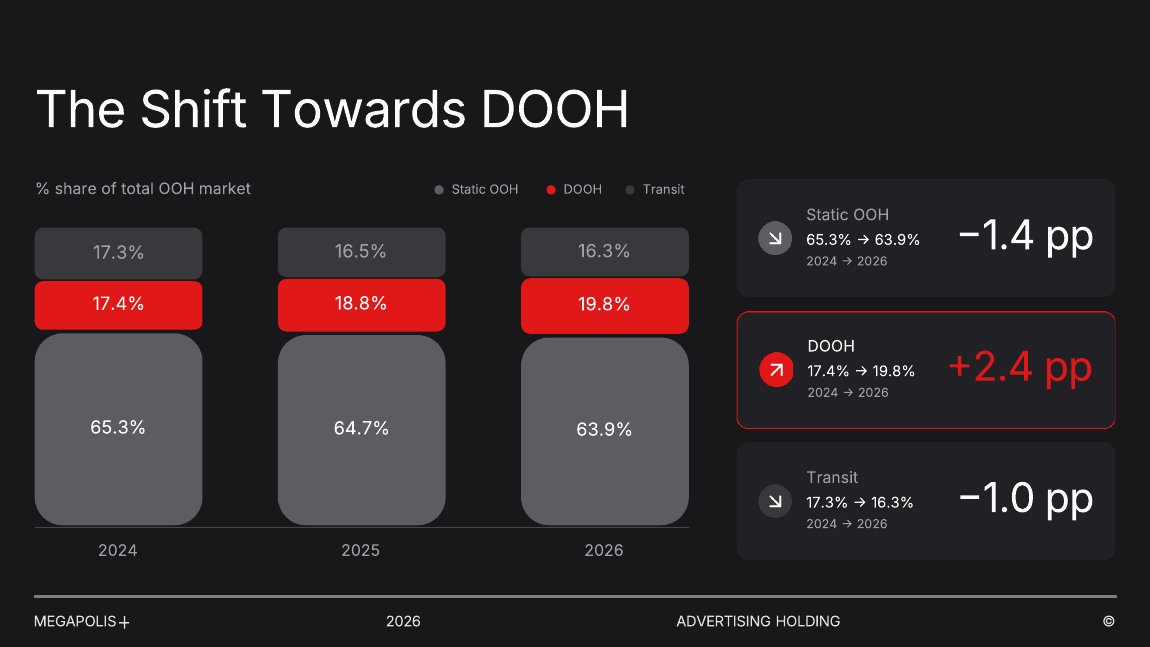
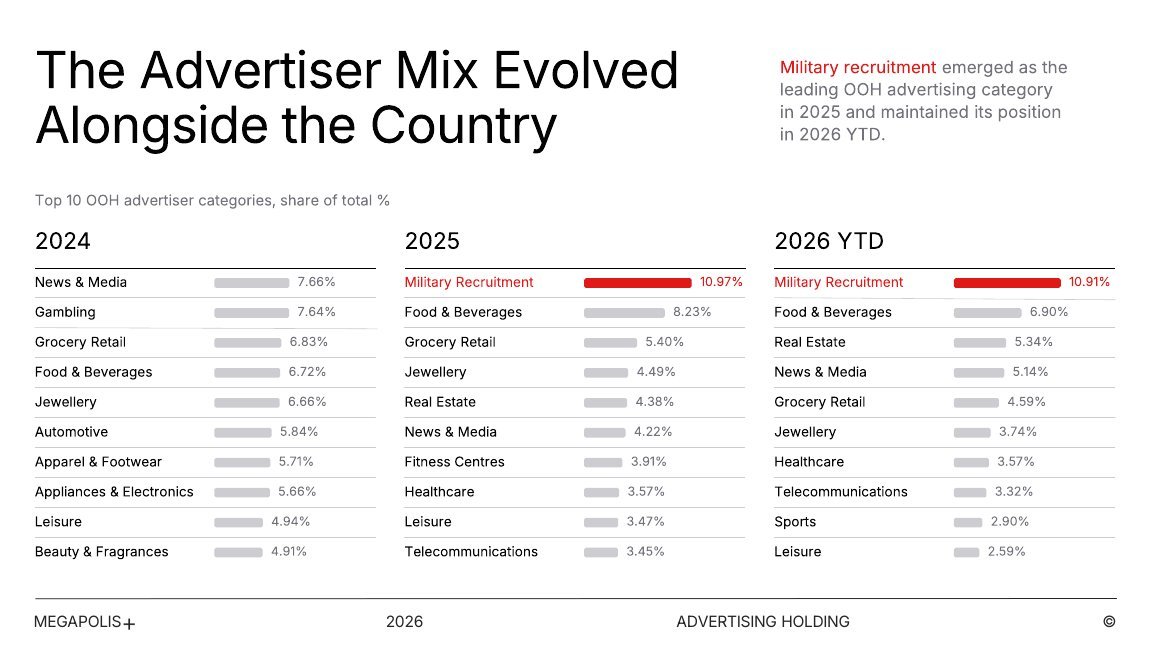
Advertisers wanted more flexible, dynamic and adaptable formats, and the market has moved accordingly. DOOH’s share of total Ukrainian OOH rose from 17.4% in 2024 to 19.8% in 2026, with static and transit both giving up share. The advertiser mix changed too: military recruitment became the largest OOH category in 2025, at just under 11%, and holds that position in 2026, ahead of food and beverages, real estate and grocery retail.
Alongside the recruitment campaigns, Ukrainian and international brands kept advertising. Ivanchenko’s closing argument was that in wartime a brand’s presence in public space carries a message that no other channel can: we are still here, still operating, still creating, still supporting people and the economy.
Ukraine is still moving. So is its OOH industry.
Viktor Ivanchenko, Megapolis+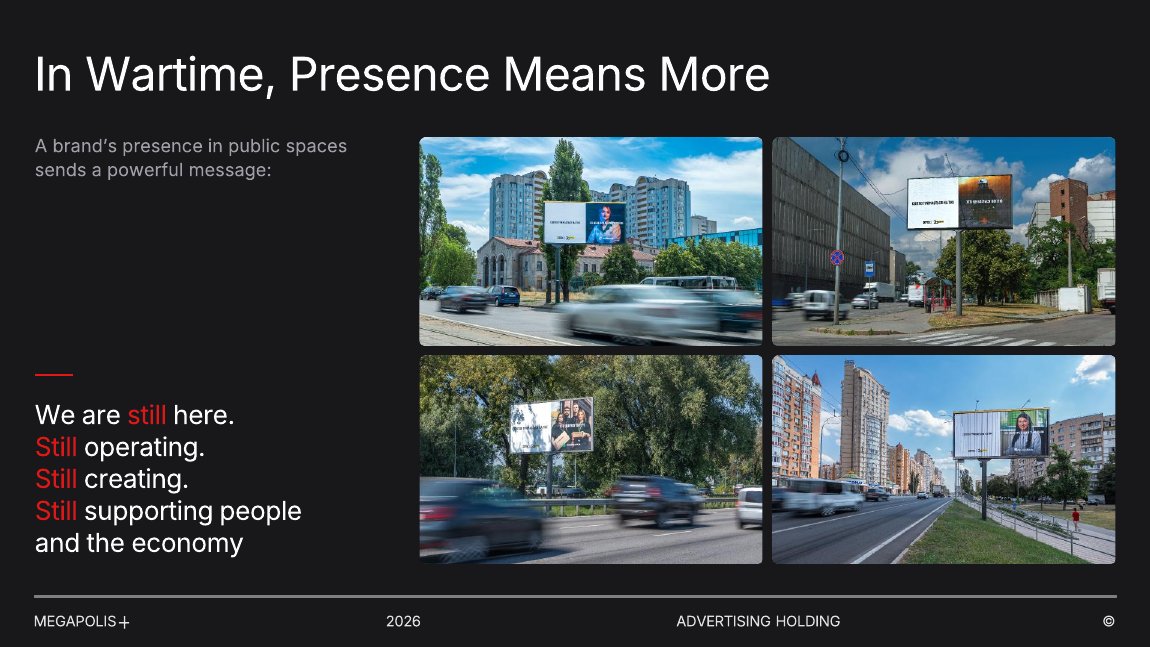 “In wartime, presence means more”
We adapted. We rebuilt measurement. We kept investing. We kept creating. Four lines on the final slide, and a case study in resilience that every OOH market, whatever its circumstances, can learn from.

Viktor Ivanchenko
Head of Strategy & R&D, Advertising Holding Megapolis+Viktor Ivanchenko is Head of Strategy & R&D at Megapolis+, with more than 20 years of experience across media research, marketing and advertising. He leads strategic planning for major brands and drives the development of data-led solutions for the OOH industry, combining audience research, Big Data, analytics and AI.
Viktor has played a key role in advancing audience-based planning, measurement and new analytical standards for OOH in Ukraine. A recognized industry expert and speaker, he regularly shares his expertise at leading national and international marketing and advertising events.
WOO Central European Forum, Warsaw 2026
Every presentation and panel from Warsaw is available to WOO members, with the speakers’ slides, through the WOO Database.