WOO London Congress 2026
Nick Brien: why IRL media can win the next decade of advertising
At WOO’s London 2026 Annual Congress, OUTFRONT Media CEO Nick Brien made a single, decisive argument: advertising is moving from an attention economy to an action economy, trust has become the most valuable economic asset a brand can hold, and real-world media is the channel best placed to compound it.
Brien framed today’s media landscape as one shaped by privacy concerns, measurement doubts, viewability questions, fraud, adverse context, lack of transparency, fragmentation and digital overload. In that environment, he argued, trust is no longer a soft brand metric — it is an economic advantage, and the channels best placed to compound it will be the ones that win the decade ahead.
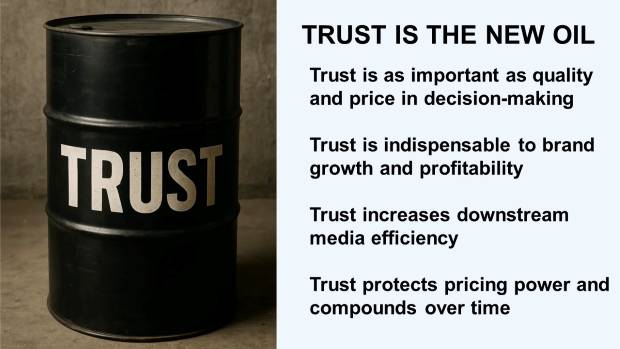
The presentation described trust as “the new oil”: as important as quality and price in decision-making, indispensable to growth and profitability, and a force that protects pricing power over time.
Set against that, the deck showed weakening confidence in digital environments — falling trust in online and mobile ads, brand social media ads, and sponsored ads and influencers. Digital advertising, Brien suggested, has too often become intrusive, repetitive, cluttered, privacy-sensitive and insufficiently relevant.
of consumers say trust is critical to product or service consideration.
are willing to spend more with brands they trust.
AI, Brien argued, only sharpens the problem. His slides asked whether AI is “better or safer”, pointing to consumer mistrust of AI search results, concern about personal data, and distrust of AI shopping assistants. Against that backdrop, he positioned IRL media not as a legacy channel but as a trusted public interface in an increasingly synthetic, automated and personalised media world.
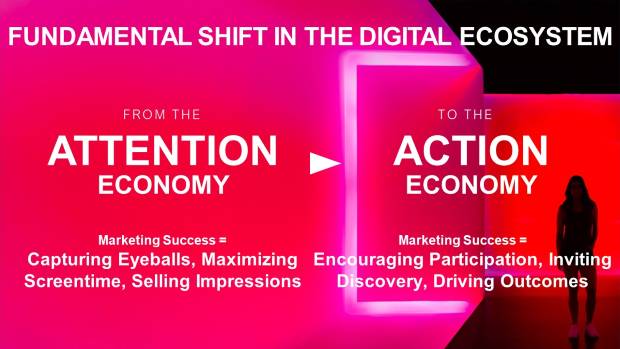
If that is the diagnosis, the prescription follows from it. Marketing success in the old model was about capturing eyeballs, maximising screentime and selling impressions. In the action economy — what Brien called the next phase of the digital ecosystem — it is about encouraging participation, inviting discovery and driving outcomes. To make that operational, the presentation reframed five of the industry’s default reflexes in terms of what the action economy will actually reward.
The shift, in five moves
The conclusion, for Brien, is that OOH equals IRL. The medium’s power lies in its publicness: it reaches people in shared spaces, connects with real journeys, carries cultural relevance and creates contextual impact.
OOH, he said, is a combination of reach, influence, attention, relevance and trust — qualities that can make it an indispensable part of omnichannel campaigns rather than a supporting channel.
For WOO delegates, the implication was direct. OOH’s next decade will not be won by arguing that the medium is bigger than digital. It will be won by proving that real-world presence builds confidence, drives discovery and turns attention into action.
In a fractured media environment, IRL may be one of the few remaining places where brands, culture and shared human experience still meet at scale.
Nick Brien, CEO, OUTFRONT Media
WOO PARTNERSThe organisations powering Out of Home worldwide
Platinum Annual Sponsor




Gold Annual Sponsor

Silver Annual Sponsor


Event Supporters
Event Platinum Sponsor

Event Gold Sponsor
Event Silver Sponsor

Event Sponsor

Event Platinum Exhibitor

Event Gold Exhibitor


Media Partners

AiOO
Platinum Annual Sponsor
AiOO is a global technology company powering the convergence of Digital Out-of-Home and Retail Media, with presence in NYC, Madrid, Dubai, and Casablanca. Our proprietary edge AI and computer-vision technology transforms physical spaces into measurable, addressable media delivering real-time, privacy-by-design audience insights and verified campaign performance.
Built for retailers, media owners, and venue operators, AiOO enables Retail Media networks to monetize in-store traffic with smarter screen planning, audience segmentation, and closed-loop measurement. In parallel, our DOOH stack supports automated operations, holistic ad serving, and programmatic activation—helping partners scale revenue while giving brands and agencies the accountability and precision they expect from digital media.
By bridging the physical world with digital-grade intelligence, AiOO accelerates the shift toward data-driven, performance-ready OOH and Retail Media worldwide.
Website: aioo.tech
LinkedIn: aioo-tech
Instagram: aioo_tech
billups
Platinum Annual Sponsor
billups is an independent global out-of-home (OOH) agency helping advertisers, agencies and OOH media owners strengthen media performance through a patented analytics and measurement platform. With over 20 years of experience and employees spanning 19 countries, their team unites local OOH expertise with global accessibility to actualize international marketing initiatives. billups uses proprietary and patented AI-powered technology to plan, optimize and report on media effectiveness, making OOH an indispensable part of media plans.
Discover how billups is reinventing OOH for the performance age at www.billups.com.
Broadsign
Platinum Annual Sponsor
Broadsign empowers media owners, media buyers, and retailers to harness the power and reach of out-of-home (OOH) to connect with audiences in ways unlike any other advertising channel. More than 2 million static and digital signs along roadways and in airports, shopping malls, grocery and convenience stores, health clinics, transit systems, and more run on Broadsign. The Broadsign Platform helps media owners and retailers, such as Outfront, Pattison Outdoor, Global, oOhMedia!,
Intersection, Sainsbury’s, Woolworths, Stellar Ace, and Douglas, maximize revenue opportunities and automate business operations. It also enables agencies like Talon, OMD Worldwide, Havas, Starcom, dentsu, Omnicom Media Group, and Publicis Groupe to seamlessly plan and execute dynamic OOH campaigns that resonate with audiences. Brands spanning AB InBev, Disney, H&M, Honda, HP, Johnson & Johnson, KLM, Uber Eats, Sea-Doo, Samsonite, and many more have run successful programmatic DOOH campaigns enabled by Broadsign technology.
Daktronics
Platinum Annual Sponsor
Founded in 1968, Daktronics is recognized worldwide as the leading designer and manufacturer of electronic scoreboards, programmable display systems, advertising displays and large screen video displays using LED technology. The company has installed more than 35,000 individual video-capable displays in more than 80 countries around the world and has multiple international manufacturing and office locations. These displays inform and entertain people throughout the world including thousands of digital billboards and many custom Out Of Home digital advertising displays in places like Times Square, New York, and Piccadilly Lights in London. Recently the company installed an 8,000 sq. ft. LED video display system at Rogers Centre, Toronto, Canada.
DynaScan
Platinum Annual Sponsor
DynaScan Technology is a leading manufacturer of outdoor kiosks, high brightness LCDs, dvLED displays, and ePaper signage—delivering premium visual display solutions for retail, smart city, and transportation applications.
Our products are engineered for 24/7 performance in high-ambient light and all-weather environments, offering exceptional visibility and energy efficiency.
From bespoke window-facing displays and weatherproof kiosks to scalable dvLED and ultra-low-power ePaper, DynaScan solutions are trusted worldwide for quality, innovation, and reliability. With offices in the U.S., Europe, and Asia, DynaScan is equipped for global rollouts and support. Learn more at www.dynascan.com.
Media Resources
Platinum Annual Sponsor

Innovating the Future for the Digital OOH Industry
As one of the leading North American LED display companies, Media Resources stands at the forefront of innovation. Our mission is simple: increase the addressable market and ROI for our OOH customers through innovative and leading digital solutions across spectaculars, roadside, airports, transit, and street furniture. At our WOO booth we will demonstrate what we have don’t to accomplish this mission.
As a 60-year-old company operating in North America, our comprehensive expertise spans engineering, design, manufacturing, installation, and service, ensuring that every project is executed to perfection. With the current geopolitical environment and our mastery of the industry in North America it is now time for us to expand our side of North America. We are pleased to be doing that as part of WOO!
If you’re a leading OOH media company seeking impactful advertising solutions to enhance your visibility, Media Resources is here to provide innovative LED display solutions and unparalleled support.
MMG
Platinum Annual Sponsor

Headquartered in the United Arab Emirates, with offices in Abu Dhabi and Dubai, BackLite Media are a specialist Out of Home media company renowned for its innovative approach and commitment to pushing the boundaries of advertising.
As the leading partner with the Roads and Transport Authority (RTA), BackLite Media boasts stand-out locations along the iconic Sheikh Zayed Road. These premier locations, combined with operations in high-profile malls, destinations, and cinema advertising venues, including The Galleria Mall, Al Qana, and Dubai Festival City, position BackLite Media as a key player in delivering unparalleled advertising reach throughout individuals' daily journeys in the UAE.
BackLite Media's success is a testament to its ability to adapt to the dynamic advertising landscape while maintaining a commitment to creativity and innovation as the company continues to shape the future of Out of Home media.
Vistar Media
Platinum Annual Sponsor
Vistar Media is the world’s leading end-to-end programmatic ecosystem for digital out-of-home (DOOH). Vistar Media’s demand-side platform (DSP) and supply-side platform (SSP) empower buyers and sellers to easily transact on DOOH inventory, while applying intelligent data insights that improve media performance. Vistar’s SaaS solutions (unified ad server and Cortex for device and content management) deliver enterprise-grade solutions for monetizing and operating digital signage networks at any scale.
Founded in 2012, Vistar Media is headquartered in New York City and has offices across the United States, Canada, EMEA and APAC. Through its global reach, direct platform integrations, data partnerships, and complete technology stack, Vistar Media continues to power innovation and growth across the digital out-of-home industry.
AllUnite
Gold Annual Sponsor
AllUnite is a global adtech company that specialises in OOH advertising audience measurement and analytics. Its technology provides real-time data on audience behaviour and ad exposure, enabling OOH media owners, advertisers, and agencies to make data-driven decisions and optimise campaign performance.
AllUnite's solutions include digital sensors and holistic data analytics tools. Headquartered in Denmark, and with offices in Italy, and Brazil, AllUnite caters to a diverse clientele across the globe.
BoE
Gold Annual Sponsor
Beijing BOE Sensor Technology Co., Ltd. is one of the four core subsidiaries of BOE Technology Group, which is dedicated to the research, development and industrialization of sensor technologies and solutions. As a key player in the field of high-performance sensors and system solutions, the company focuses on multiple sectors, including consumer electronics, intelligent perception, healthcare, biology, and industry.
Relying on BOE Group's profound knowledge accumulation in the semiconductor display field, the company has deeply integrated diverse sensing technologies to address customers' problems comprehensively. Our highly customized solutions for DOOH (Digital Out-of-Home) customers are meticulously designed to enhance product reliability, enable fault prediction and alarm functions, and significantly reduce equipment maintenance costs.
Contact for more information?zhoujian-hq@boe.com.cn
Moving Walls
Silver Annual Sponsor

Moving Walls is a media technology group with a presence in seven markets across four continents. The group operates a myriad of technology for both the demand and supply sides of Out-Of-Home (OOH). For planners and buyers, Moving Walls operates ‘Moving Audiences’, a patented multi-sensor approach to location-based media measurement like billboards, digital signage, and transit media. For asset owners, the group’s supply-side subsidiary, Location Media Xchange (LMX) is a platform for marketers to profile locations based on the types of audiences around the site and activate mobile and physical place-based media like digital billboards to reach them during this offline journey.
Ipsos
Silver Annual Sponsor

Ipsos - world leader in Out of Home measurement.
Ipsos operates OOH solutions in 17 different countries. (11 recognised industry currencies). We offer the most accurate and reliable insights for media owners, media agencies and brands. People-centric measurement Ipsos provides a total understanding of audiences. Our approach centres around understanding people and is how we build solutions reflective of local environments. We leverage the best in technology, national data sources and our research expertise to deliver realistic representative OOH data for any market need.
Global Expertise Ipsos is present in over 90 different countries. Our local knowledge is supplemented by a central global OOH team which includes the expertise of MGE Data. (OOH Data and Technology specialists who design, develop and manufacture equipment and software.) This mix of global and local expertise enables us to offer tailored contemporary solutions, ensuring our clients have the most accurate datasets for media planning and advertising. We continually invest in our audience measurement capabilities.
Our scale and expertise in data science ensures our tools are future ready. We help our clients to unleash the power of audiences.
Unilumin Group
Silver Annual Sponsor
Unilumin, is the LED application pioneer, established in 2004, providing professional LED application services, including the world's leading LED display and lighting products and Metasight solutions. The company was listed on the Shenzhen Stock Exchange in 2011 (XSHE: 300232) and has consistently been leading in LED display industry exports for 8 consecutive years, earning the trust and support of customers worldwide.
“21th anniversary is a milestone moment for Unilumin in 2025, representing that Unilumin has led the field in stably, maturely, competitively. Looking forward to the future, Unilumin will steadfastly work with partners to formulate more specific goals and prepare for the next more years of development.
Learn more: www.unilumin.com
VIOOH
Silver Annual Sponsor
VIOOH is a leading premium global digital out of home supply-side platform that connects buyers and sellers in a premium marketplace, making OOH easily accessible.
Led by a team of digital OOH and programmatic tech experts, VIOOH is pioneering the transformation of the OOH sector, championing its role in enhancing omni-channel digital campaigns through the use of programmatic capabilities and data. VIOOH currently trades programmatically in 22 markets and provides access to inventory from some of the world’s top DOOH media owners, including APG, Branded Cities, Framen, In-store Media, JCDecaux, Media Frankfurt, Media Transports, and more.
For more information about VIOOH, please visit www.viooh.com or follow us on X (Twitter) and LinkedIn.
THE LED
Event Platinum Sponsor
Innovation, technology, and infinite possibilities
Founded in 2010 by Richard Albanesi, THE LED was born with a bold mission: to revolutionize visual communication through technology. A pioneer in LED panel rentals for events, the company quickly evolved into a market leader in full-service digital solutions across Brazil and expanded its presence throughout Latin America.
With a robust in-house structure — including a metalwork factory, an internal 3D content studio, and proprietary systems — THE LED delivers 360º solutions for retail, out-of-home media, shopping centers, and major brands. Its portfolio includes projects with industry leaders such as Eletromidia, Multiplan, Carrefour, Pão de Açúcar, SBT, and RZK.
Renowned for its spirit of innovation, THE LED has introduced groundbreaking formats like immersive LED tunnels, transparent LED storefronts, and interactive activations. Its work has earned top accolades, including the SHOP Awards, Prêmio Caio, and Popai Brasil.
Guided by its slogan — infinite possibilities — THE LED blends creativity, technology, and strategy to transform brand experiences and deliver real impact.
Wildstone
Event Platinum Sponsor
Wildstone is a leading owner of outdoor media infrastructure, operating across the UK, Europe, and Australia. The company’s portfolio of over 5,400 out-of-home advertising assets includes digital advertising screens in a variety of formats, classic billboards, and super premium digital sites.
Wildstone partners with media operators by offering new OOH locations as well as expertise and capital investment needed to digitise sites. This collaboration enables media owners to accelerate growth, boost revenue, and concentrate on their core business of selling OOH advertising.
Wildstone is shaping the future of outdoor advertising through the digitisation of out-of-home assets.
Visit www.wildstone.co.uk to find out more.
Outdoorlink
Event Gold Sponsor
Outdoorlink is a leading provider of remote device management solutions for the Out-of-Home (OOH), Digital Out-of-Home (DOOH), and Retail Media industries. Founded in 2007, our agnostic, cellular-based hardware enables real-time monitoring, alarms, troubleshooting, and remote management of billboard lighting and digital displays, helping operators maximize uptime, reduce maintenance costs, and improve operational efficiency.
Outdoorlink supports one of the largest connected OOH networks in the world, with more than 100,000 controllers across 25+ countries, supporting over 150,000 static illuminated faces and 15,000+ digital faces on our platform.
With a growing international footprint and an expanding product portfolio, we deliver reliable, scalable technology that powers the next generation of out-of-home media.
GDS Solutions
Event Silver Sponsor
For more than 45 years, Global Display Solutions (GDS) has been at the forefront of developing and manufacturing real-time passenger information displays with the best available display technologies: LCD-TFT, LED and E-PAPER.
We are passionately committed to pioneering new displays technologies while delivering total customer satisfaction in the design, manufacturing, installation and lifetime support of our display solutions.
Our goal is to provide eye catching display performance at lowest total cost of ownership.
Our display solutions are evident in everyday life – from drive thru menu boards to information displays on your daily bus or rail commute to the office. From fuel pump price displays to advertising displays at the shopping mall, GDS provides customized display signs, solutions and services to a wide range of clients across diverse markets.
GDS uniqueness is in our relentless innovation of technology and products, as well as in our organization and how we meet our customers’ needs.
It is not just innovation, but innovation shaped around our customers.
Purl Applications Limited
Event Silver Sponsor
Purl Applications Limited provides software solutions that simplify Out Of Home (OOH) Media Planning, Trading, Buying, Creative Delivery and Reporting.
Our software streamlines the OOH media ecosystem, removing intermediaries, and connecting workflows into a consolidated and transparent chain.
- We reduce: friction, complexity, time required, cost of sale, inefficiencies, and unnecessary moving parts.
- We connect: buyers to sellers; trading systems to each other.
- We simplify: planning, trading, buying, and reporting.
- We automate: media planning, trading, buying, and reporting.
- We improve: transparency, accountability, operational efficiency, user experience, and the effectiveness of OOH campaigns.
dooh.direct is Purl’s cloud-based SaaS tool for Agencies and Media Owners to visualise and trade Out Of Home inventory and audiences. It enables manual and programmatic 'buy forward' and 'buy now' trading of Traditional and Digital Out Of Home media.
For Media Owners, dooh.direct enables both classic and digital OOH inventory to trade via offline and programmatic trading channels (OpenDirect and OpenRTB).
Purl’s tools empower media owners to sell what inventory they want, how they want and ensure clarity, buyer understanding and a guaranteed PO.
For Agencies, dooh.direct makes Out Of Home media accessible, understandable, executable, and measurable.
Purl products increase speed to market, allowing access of manual, automated and programmatic trades in one platform.
dooh.direct connects planning, trading, creative and reporting tools directly to core agency finance and billing infrastructure, delivering clear, measurable outcomes with consistent accountability.
Since its launch in 2020, Purl Application Limited’s products have driven over £600m of media investment into the out-of-home market, working with Agencies such as Zenith, Spark, Starcom, PG One, Qube, Rapport, MX Location and Wilkins Media, supporting leading global brands including Meta, Disney, Paramount, Mondelez, LVMH, Nestlé, Puig, TikTok, VISA, Coty and Procter & Gamble
Absen
Event Sponsor
Established in 2001, Absen (SZSE: 300389) is the world's leading LED display products and service supplier. Absen’s products are exported to 165 countries and regions in America, Europe, Australia, Asia, Africa, etc., and have been used in the Presidential press conference, CIIE, FIFA World Cups, NBA games and Times Square.
Delivering more than 65,000 installations, Absen produces best in class products for DOOH , rental & staging , commercial display , data visualization, conference display and consumer markets, with the export volume of LED products being NO.1 for 16 consecutive years.
Altemark
Event Sponsor
WE ARE OOH ADDICTS
Altermark’s team is 100% dedicated to OOH. We sleep, eat and breath OOH. Our team is immersed in markets rhythm and therefore delivers exceptional and relevant OOH campaigns.
ECN
Event Sponsor
Since 2004, ECN has connected brands with affluent professionals through premium office environments. Today, ECN operates Europe’s largest office media network, spanning 25 cities, 900+ DOOH screens, and 600+ locations across the UK, Germany, France, and Belgium, reaching audiences working within 6,000+ leading global and local companies.
Built around high-attention environments, long dwell times, and repeated office attendance, ECN helps brands engage influential audiences where attention works.
Discover ECNs network here Executive Channel Network.
GIMC
Event Sponsor
GIMC was founded in 1979 as one of the earliest advertising agencies in China. Today, it stands as one of the strongest marketing groups in the country, headquartered in Guangzhou, China. Committed to the philosophy of "creating value for clients," GIMC provides professional marketing services to over 300 renowned companies worldwide. In 2010, GIMC was listed on the Shenzhen Stock Exchange (Stock Code: 002400), becoming the "first advertising and marketing stock in China."
GIMC has more than 60 member companies, with annual operating revenue exceeding RMB 20 billion and total assets surpassing RMB 10 billion. Its service network covers all major regions of China. In 2016, GIMC became the first marketing group to be included in the Fortune China 500. In 2018, it received the "National May Day Labor Award," the only marketing group ever to receive this prestigious national honor. In 2024, GIMC was designated a "National Advertising Industry Park," setting a benchmark for national-level innovation in the advertising industry.
GIMC offers full-service capabilities, providing over 300 clients worldwide with one-stop, full-marketing solutions, including brand management, media agency, digital marketing, and cross-border marketing. It has developed a portfolio of digital and intelligent marketing products, including GIMC Cloud, Lingxi AI, and Jingpeng Ad Delivery, providing smarter, personalized big-data solutions to meet diverse client needs. In 2024, it was recognized as the Guangdong Provincial Engineering Technology Research Center for Performance Marketing.
Over 47 years, the trust of clients and the baptism of the market have fueled GIMC's surging momentum in innovation, creating a development miracle in the history of Chinese advertising. GIMC will continue to pursue excellence, drive holistic growth through intelligent marketing, lead the transformation of the intelligent marketing industry, promote Chinese brands worldwide, and continuously create value for shareholders, clients, and employees, striving to become an outstanding global intelligent marketing group.
Hills Advertising
Event Sponsor
Established in 2003, Hills Advertising is a leading outdoor advertising company headquartered in the UAE. Renowned for its comprehensive range of out-of-home (OOH) advertising services, the company operates across the entire value chain, offering expertise in urban planning, advertising design and coding, production, ad space sales, operations, maintenance, and related services. Hills Advertising seamlessly integrates traditional and digital media to deliver impactful OOH campaigns.
The company holds strategic partnerships and contracts in Dubai and Jordan, including prestigious collaborations with the Dubai Roads and Transport Authority (RTA) and Aqaba Development Corporation. With a dominant market share, Hills Advertising controls approximately 50% of Dubai RTA’s OOH advertising contracts, solidifying its position as the leading owner of ad spaces on Sheikh Zayed Road bridges, one of the UAE’s most strategic advertising corridors.
Hills Advertising has become a trusted advisor and consultant to public authorities and master developers in Dubai and Jordan, providing critical guidance on urban planning, OOH advertising regulations, and media space management. Its extensive experience includes collaborations with key stakeholders such as Dubai Municipality and RTA, shaping the development of industry standards and regulations.
With a direct presence in the UAE and Jordan and operations spanning more than 15 countries through affiliates and partnerships, Hills Advertising boasts a robust global footprint. This enables the company to manage international OOH advertising campaigns with precision and efficiency. Backed by two decades of expertise and a reputation for innovation, Hills Advertising continues to set new benchmarks in the outdoor advertising industry.
LEMMA
Event Sponsor
The Neuron
Event Sponsor
The Neuron
Ocean Outdoor
Event Sponsor
Our art is turning Spaces into Places™
Turning spaces into places brings your brand closer to the audiences you desire. We showcase brands, blending creativity, technology and insight to maximise stoppability and shareability. We do this by placing digital OOH advertising in spaces positioned to prime and designed to delight.
Politis Group
Event Sponsor
Politis Group is the leading Out of Home media owner in Greece in the non-moving media sector, with more than 40 years of continuous presence in the market. We operate an extensive national network of over 9,2 digital and classic advertising frames, covering 69 cities and municipalities and delivering 6.9 billion impressions every 28 days to 7.2 million unique individuals.
With more than 9K active advertising points and a team of 153 professionals, Politis OOH combines scale, operational control, and technological integration to deliver reliable, measurable and high-impact outdoor advertising solutions.
Market Presence & Infrastructure
Our portfolio spans high-traffic urban environments, premium roadside locations, city centers, and retail proximity networks. We manage a balanced mix of classic static formats and a rapidly expanding digital ecosystem, including large-format LED screens, interactive panels, and special constructions.
As a non-moving media specialist, our focus is on maximizing visibility in strategic, fixed locations that guarantee sustained exposure and consistent audience delivery.
Fully Integrated Operations
- Politis OOH manages the entire campaign lifecycle in-house, ensuring operational consistency and quality control at every stage:
- Idea & Creative Development – Conceptual support and adaptation for OOH environments.
- Design & Technical Planning – Functional design optimized for location, format, and visibility.
- Production – Print, digital, 2D and 3D constructions executed with certified production standards.
- Distribution – Fleet of 52 vehicles ensuring nationwide logistics coverage.
- Installation – 72 specialized technicians handling installations across all network locations.
- Maintenance & Support – Continuous monitoring and maintenance of all frames to ensure uptime and presentation quality.
This vertically integrated structure allows us to maintain high operational standards and deliver campaigns efficiently across multiple cities simultaneously.
Data & Measurement
We actively invest in measurement and accountability. Through strategic partnerships with Vodafone and TomTom, and mobility data analysis via the Carto platform, we provide advertisers with campaign performance insights based on real movement patterns and traffic data.
Our approach enables:
- Audience reach validation
- Mobility-based exposure analysis
- Performance reporting per location cluster
- Data-backed media planning optimization
We consider measurability a core pillar of modern OOH and continue to expand our data integration capabilities in line with international best practices.
Technological Innovation & Digital Expansion
While maintaining a strong static footprint, we are continuously expanding our digital OOH capabilities. Our network includes interactive touch-screen panels, dynamic content capabilities, real-time message adaptation via QR technology, and large-format LED structures.
We also support advanced creative executions including 3D builds and digitally enhanced content formats such as FOOH (Fake Out of Home) productions for cross-channel amplification.
Our focus is on combining physical presence with digital flexibility, ensuring that OOH remains both impactful and adaptable within today's omnichannel media landscape.
International Presence
Greece
Market leader in non-moving OOH media, with nationwide coverage across major metropolitan areas and regional cities.
Cyprus
Selective premium network including illuminated Pisa, Super Pisa, and large-format billboards positioned in key urban and roadside locations.
Romania
Based in Bucharest, providing access to high-traffic premium outdoor locations across the capital and other major urban centers, supporting growth in one of the region's dynamic OOH markets.
For over four decades, Politis OOH has focused on building infrastructure, expanding digital capability, and strengthening measurement standards in the Out of Home sector. Our commitment is to operational excellence, network quality, and continuous innovation within the evolving global OOH landscape.
YAHAM
Event Sponsor
YAHAM, founded in 2002 and headquartered in Shenzhen, China, is a global manufacturer of LED display, traffic VMS and lighting solutions. With over 20 years of engineering and production experience, the company delivers reliable, application-driven display systems for outdoor media, infrastructure, and commercial projects worldwide.
YAHAM has completed landmark projects across major global cities including New York, Tokyo, and Amsterdam, and has supported large-scale developments such as the Shenzhen International Exhibition Center.
Focused on engineering quality, customization, and long-term reliability, YAHAM works with cities, brands, and partners to create impactful and dependable visual experiences.
Perion
Event Platinum Exhibitor
Perion helps brands get better results from their marketing investments by bringing creativity and AI together in one connected platform. With Perion One, we unify data, channels, and storytelling so campaigns don’t just run - they adapt, optimize, and deliver meaningful performance across display, video, CTV, DOOH, audio, and walled gardens.
Artcrush Gallery
Event Gold Exhibitor
At Artcrush, our mission is to break art out of its elitist bubble. We flip the script: instead of asking people to seek out art, we bring art to where they already are - waiting at the bus stop, standing on a train platform, or stuck in traffic. Between two ads on a billboard, they’re offered a fleeting moment of beauty - a work of art, freely and unexpectedly.
The streets of the world become a permanent, open-air art experience - a vast and evolving exhibition space.
The street is our gallery: Artcrush makes art truly accessible and alive, transforming public space into a place of connection, between art, individuals, and local communities.
Our exhibitions run daily across a growing network of countries and digital billboards.
This large-scale is made possible by two kinds of visionary partners:
- Digital billboard companies who generously offer unused ad space - boosting the cultural value of their networks and supporting efforts to improve regulation for digital signage.
- Purpose-driven brands - from commercial companies to galleries and institutions - who fund or co-create cultural campaigns with artists, leaving a lasting imprint on public space and in people’s hearts.
At its core, Artcrush exists to help artists bloom, make people smile, and help our partners - both billboard owners and aligned brands—shine.
MediaKeys
Event Gold Exhibitor
Mediakeys is the world's premier independent global Out-of-Home agency. 32 years, 20 owned offices, 100+ markets, one team.
We turn your marketing goals into campaigns that perform - from strategy and planning through buying, execution and measurement - with our own in-house team on the ground in every market. They know the landscape like locals - because they are.
Our proprietary technology stack - including the GlobalAd worldwide planning platform and the Arago DSP - bridges offline and online, giving clients the intelligence, targeting precision and performance measurement to maximize every market, every time.
Trueform
Event Silver Exhibitor
Trueform, a pioneering technology and manufacturing company, provide the design, manufacture, installation and maintenance of premium quality, intelligent solutions for Public Transportation, Intelligent Mobility, Smart City, Zero Emission and Digital Display communication.
ADZYMIC PTE LTD
Event Silver Exhibitor
Adzymic is an award-winning omnichannel advertising platform built for the agentic era. Combining a Creative Management Platform, Dynamic Creative Optimisation engine, and curated Premium Exchange, Adzymic gives brands and agencies an end-to-end suite to create, personalise and activate high-impact rich media campaigns across display, video, CTV and DOOH.
Trusted by leading brands and agencies worldwide, Adzymic powers campaigns for some of the world's most recognised advertisers, delivering measurable engagement and performance at scale. As advertising shifts toward autonomous execution, Adzymic is building the infrastructure for AI to plan, create and optimize campaigns across every touchpoint, end to end. www.adzymic.ai
Cuende Spain
Event Silver Exhibitor
At CUENDE, we're transforming how Out-of-Home Advertising is measured with cutting-edge technological solutions. We combine technology, innovation, and experience to offer the most advanced and effective measurement in Out-of-Home Advertising.
Our award-winning systems are used by Out-of-Home companies, advertisers, agencies, and international associations seeking reliable data to optimize their out-of-home communication strategies.
DoohClick
Event Silver Exhibitor
DoohClick is more than a Content Management System (CMS) – it’s a complete ad management platform built for OOH media owners. Designed by industry experts, DoohClick brings together campaign scheduling, sales, reporting, and revenue tracking in one smart, scalable system.
Automate proof-of-play, track real-time screen availability, respond to RFPs faster, and generate insights to optimize your business. Seamlessly integrate with existing CMS and finance systems, reduce admin, and unlock new revenue opportunities. Whether you manage static or digital inventory, DoohClick gives you full control—from proposal to final playback. Visit us at our stand in Mexico to see it in action.
Esprit Digital Ltd.
Event Silver Exhibitor

Esprit Digital is a trusted AV integrator and manufacturer of LEDs, Totems, and Kiosks.
We deliver bespoke, high-performance, digital display solutions for some of the world’s most recognisable brands and locations.
With over 20 years of expertise, we specialise in designing, fabricating, and integrating display networks that transform high-footfall environments into engaging, technology-driven experiences.
Esprit has a distinguished record of success, winning multiple industry awards and was recognised with both the Queen’s Award in 2016 and the King’s Award last year.
Longstanding media owner customers include: Westfield, JCDecaux, Ocean, Private Jet Media, Times of India, Backlite, Al Arabia, Elan and Pikasso.
Falcon Tech Robotics
Event Silver Exhibitor
Kody Technolab Limited is a publicly listed deeptech company at the intersection of robotics, AI, and platform engineering.
Evolving from software to full-stack robotics, Kody builds and deploys intelligent machines integrated with analytics and IoT. Its portfolio of AI-powered robots includes, Odigo (AI advertising & concierge robot), Popper (Beverage promotion & serving robot), Dasher (food serving robot), Vulcan (Heavy-duty industrial cleaning robot), Spilot (Autonomous Mobile Robot) and more.
Falcon Tech Robotics is Kody Technolab Limited’s venture in the GCC region, delivering robotic solutions with regional deployment, support, and partnerships across malls, hospitality, healthcare, and smart facilities.
The Siroky Group
Event Silver Exhibitor
For over three decades, The Siroky Group has partnered with Out of Home (OOH) media owners to modernise the way advertising assets are sold, managed and delivered. We provide purpose-built software and strategic consulting designed specifically for the OOH sector.
Our solutions streamline sales processes, improve operational efficiency and increase visibility across the media lifecycle — enabling organisations to scale with confidence in a rapidly evolving marketplace.
Combining deep industry expertise with practical system design, we support media companies in strengthening governance, enhancing performance and making better-informed commercial decisions.
AOTO
Event Silver Exhibitor
AOTO is a global LED display manufacturer and intelligent visual solutions provider focused on digital-out-of-home media.
From landmark billboards to transit media networks, AOTO delivers reliable, high-quality LED solutions across major urban environments worldwide.
With over 180,000 advertising projects delivered globally, AOTO supports DOOH networks through energy-efficient technology and long-term operational reliability.
Behind The Billboard
Media Partners
Billboards have incredible power. Of all the media platforms, they have the ability to cut through culture and change a brand’s fortunes in seconds. So what is the secret to using the most powerful tool in the media landscape?
- What makes a world-class billboard’?
- What wins awards?
- What gets on the news?
- What trends on social?
- What does it take to bring incredible OOH campaigns come to life?
- What are the stories behind these brilliant billboards?
The ‘do’s’. the ‘don’ts’, the ‘oh-so-nearlys’ and the ‘WTFs’. Who are the people, who are the brands and what are their stories. Our series aims to find out.
Beyond The Billbord
Media Partners
A Podcast about insightful & topical Out of Home advertising discussions with key industry experts created to educate and inspire. Join OOH Experts and Co-Hosts; Livia Brown & Kirsty Carlson as they go Beyond The Billboard to discover the world inside Out of Home.
The Media Leader_
Media Partners
The Media Leader is the media industry’s leading source of news analysis, data, and opinion. We are an independent publishing brand owned by Adwanted Group and in 2022, we rebranded from Mediatel News and launched a dedicated site and newsletter in the US.
The Media Leader is the advertising industry’s go-to resource for quality analysis, opinion and news about media and its intersection with advertising.
The publication introduced brand values that guide the title’s coverage: championing excellence, inclusion and courage in media. These values are put into editorial practice by consulting our audience and the wider industry about what are the most pressing issues that need to be improved.
Adwanted UK is the leading provider of media tech and data, with decades of experience across the media landscape. Adwanted Connected is the UK’s largest single-source of media data for agencies, media owners, brands and academic institutions.
In recent years the company has also grown an internationally-renowned events business, Adwanted Events, which runs over 20 global conferences annually including The Future of Media and The Future of TV series.